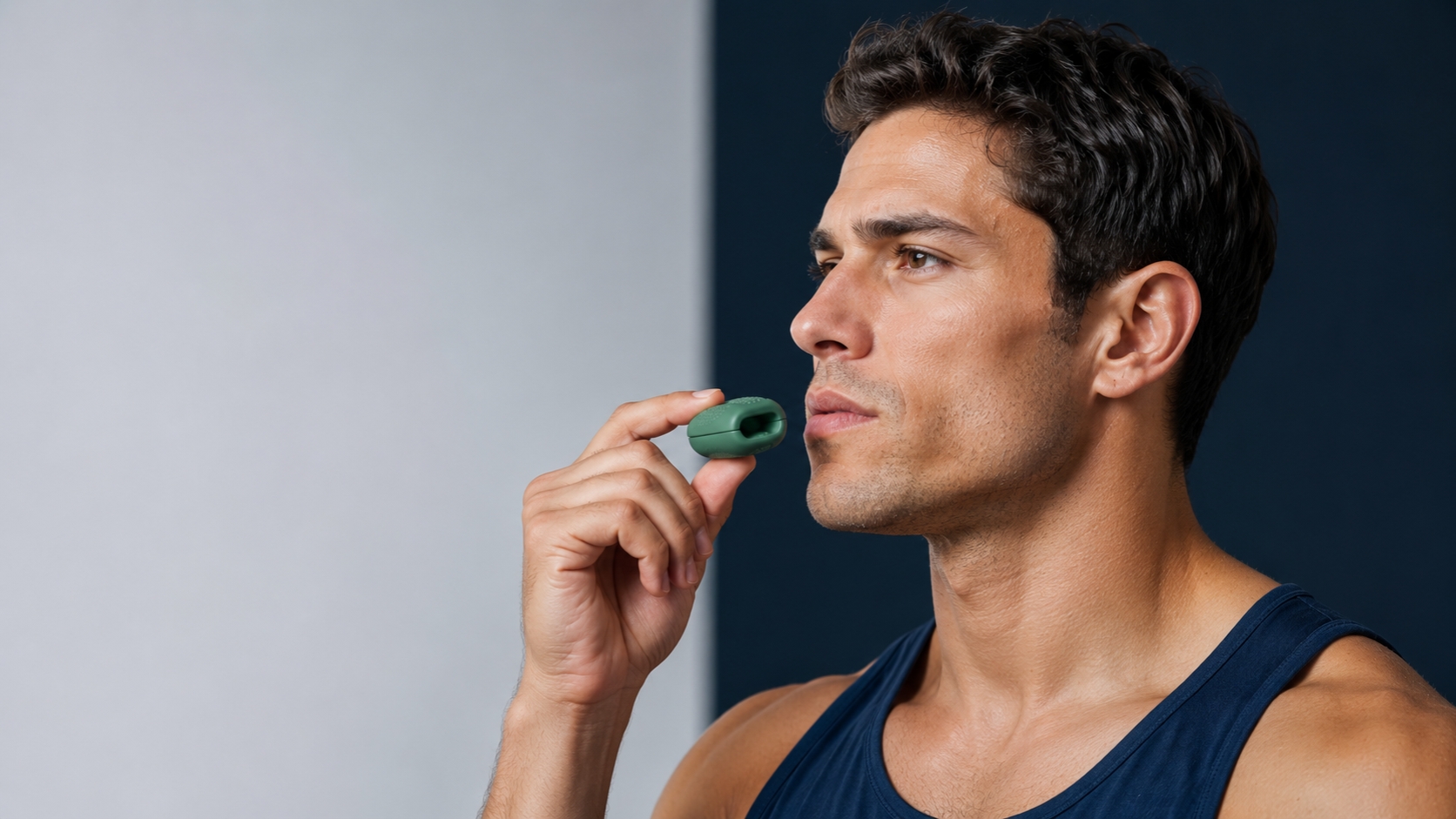
Research-based evidence guide — HealthAffPro did not physically test a jaw exerciser. The 2024 chewing study and NIDCR jaw-health guidance were rechecked September 29, 2026. Study findings are not product-specific proof.
Comparing actual products? Our Jawzrsize vs Chisell guide covers design and purchase risk; the Jawzrsize Review looks at one product’s buyer fit.
Jaw exercisers make the chewing muscles work against resistance, but current research does not show that commercial devices reliably create a sharper jawline or remove a double chin. Chewing-training research suggests bite strength can improve, but that is different from proving a visible cosmetic change.
What should you know before trying a jaw exerciser?
- A stronger bite does not automatically mean a sharper-looking jaw.
- Research on chewing training is more useful for understanding jaw function than for proving cosmetic results from commercial devices.
- Direct human research on commercial jaw exercisers for facial contouring remains limited.
- Jaw exercisers are not established treatments for removing fat under the chin.
- Therapeutic jaw exercises used for TMD are not the same as consumer bite-resistance devices.
Do jaw exercisers actually work?
They can provide resistance to the muscles used for chewing, but research is more convincing for changes in jaw function than for visible facial reshaping.
The training group increased maximum bite force. The study did not find a significant change in the thickness of the masseter, one of the main chewing muscles, or in the shape of the lower jawbone.
Chewing resistance may improve how strongly the jaw functions without necessarily making the lower face look larger or more defined.
The study tested chewing gum, not Jawzrsize or another commercial bite-resistance device. Its findings should not be used as proof that a specific consumer product produces the same result.
Which jaw exerciser claims are supported by research?
Functional jaw-training claims have more support than cosmetic claims. The table below separates the main reasons people consider these devices.
| Your goal | What current evidence shows | Practical takeaway |
|---|---|---|
| Improve bite strength | Gum-chewing training has improved maximum bite force in controlled research. | Functional evidence exists |
| Make jaw muscles visibly larger | Visible enlargement is not guaranteed. The six-month chewing trial did not find a significant increase in masseter thickness. | Uncertain |
| Get a dramatically sharper jawline | Direct research on commercial devices is very limited and has not established reliable cosmetic improvement. | Weak evidence |
| Remove a double chin | Current jaw-exerciser research has not established these devices as a treatment for fat under the chin. | Not a supported use |
| Treat TMJ/TMD symptoms | Therapeutic exercise may help some people with TMD, but commercial resistance devices have not been established as equivalent treatment. | Do not use as self-treatment |
Can a jaw exerciser make your jawline look sharper?
Current clinical evidence is too limited to promise a noticeably sharper jawline. Making chewing muscles work harder does not by itself prove that the visible outline of the lower face will change.
The two cases did not show a noticeable improvement in jaw appearance. The researchers also reported limited evidence supporting cosmetic claims such as jawline enhancement and double-chin reduction.
Two cases are far too few to predict what will happen for every user. The study mainly shows how little direct human evidence is currently available for cosmetic jaw-exerciser claims.
Source: Verma et al., Cureus
What should you do instead if you want a sharper-looking jawline?
Start by identifying what you actually want to change rather than assuming a jaw exerciser solves every lower-face concern.
Do not treat a jaw exerciser as a proven fat-removal treatment. If the concern is significant enough that you want treatment options, discuss the cause and appropriate options with a qualified healthcare professional.
Treat this as a health concern rather than a cosmetic training problem. Persistent pain, stiffness, locking, or restricted jaw movement may warrant professional assessment.
Keep expectations modest. Current research does not establish commercial jaw exercisers as reliable facial-sculpting devices.
Functional research is more encouraging, but results from gum-chewing studies should not automatically be applied to every commercial resistance device.
Can a jaw exerciser affect your teeth, braces, or dental work?
There is not enough direct research to give one safety answer for every device and every type of dental work. If you have braces, veneers, restorations, or other significant dental work, do not assume repeated bite resistance is automatically suitable.
What if you have braces?
The American Association of Orthodontists advises patients with braces to avoid hard or demanding biting that could damage brackets or wires. That guidance does not directly test jaw exercisers, so it cannot prove that a specific device will damage braces.
Practical takeaway: ask your orthodontist and check the product’s specific instructions before using a bite-resistance device with braces.
What if you have veneers?
ADA MouthHealthy guidance advises people with veneers to avoid chewing on hard objects or foods. This does not prove that every jaw exerciser will damage a veneer, but it is a reason not to assume repeated resistance biting is appropriate without checking first.
What about crowns, implants, or other dental work?
The sources used for this article do not provide enough direct evidence to give a universal rule for every crown, implant, or restoration. Ask the dentist familiar with your dental work before adding repeated bite resistance.
Sources: American Association of Orthodontists · ADA MouthHealthy
Can jaw exercisers help TMJ or TMD problems?
Do not treat a commercial jaw exerciser as a proven treatment for TMD. Research supports certain therapeutic exercises for some people with temporomandibular disorders, but those exercises are not the same as independently using a cosmetic bite-resistance device.
A systematic review with meta-analysis found that therapeutic exercise reduced pain and improved mouth opening in people with temporomandibular disorders. These findings apply to therapeutic exercise programs, not automatically to commercial jaw exercisers.
NIDCR also recommends conservative care for many TMD problems and notes that gentle stretching or strengthening may be used in appropriate situations under professional guidance.
Sources: Idáñez-Robles et al., Clinical Rehabilitation · NIDCR
When should you stop using a jaw exerciser?
Stop rather than pushing through new or worsening jaw symptoms.
Stop and seek professional advice if you develop:
- Persistent or worsening jaw or chewing-muscle pain
- Jaw locking
- Difficulty opening or moving your jaw normally
- Painful clicking, popping, or grinding
- A noticeable change in how your upper and lower teeth fit together
NIDCR notes that clicking or popping without pain can be common and does not necessarily require treatment. Pain, locking, restricted movement, and painful clicking are more relevant warning symptoms.
Source: National Institute of Dental and Craniofacial Research
Is a jaw exerciser worth buying for your goal?
It makes more sense as an experimental resistance tool than as a proven cosmetic treatment.
| If your goal is… | Evidence-based takeaway |
|---|---|
| A dramatically sharper jawline | Current evidence is too weak to buy one for this reason alone. |
| Double-chin removal | Not an established use. |
| Experimenting with chewing resistance | Potentially relevant, but device-specific benefits are uncertain. |
| Treating TMJ/TMD | Do not use it as a substitute for appropriate clinical care. |
| Using one with braces or significant dental work | Check with your dentist or orthodontist first. |
What should you check before buying a jaw exerciser?
Check whether the product’s claims match the evidence rather than judging it only by before-and-after marketing.
- Decide whether your main goal is functional or cosmetic.
- Check whether a company’s cited research actually tested its product.
- Be cautious with guaranteed jawline or double-chin claims.
- Read the product-specific warnings and instructions.
- If you have braces, significant dental work, or ongoing jaw symptoms, seek appropriate professional guidance before adding repeated bite resistance.
Still considering Jawzrsize?
Our separate review looks specifically at Jawzrsize’s features, advertised claims, limitations, and available evidence so you can compare the product with your actual goal.
Read the Jawzrsize Review →Frequently Asked Questions
Current clinical evidence does not show that commercial jaw exercisers reliably create a sharper jawline. Direct device research is limited, so dramatic cosmetic results should not be treated as established.
Visible enlargement is not guaranteed. A six-month gum-chewing trial improved maximum bite force but did not find a significant increase in masseter muscle thickness. Importantly, that study tested gum chewing rather than a commercial jaw exerciser.
Current jaw-exerciser research does not establish these devices as a treatment for fat under the chin. Do not buy one expecting proven double-chin removal.
Do not assume that you can. Orthodontic and veneer-care guidance recommends caution with hard or demanding biting forces, but these sources do not directly test jaw exercisers. Ask your orthodontist or dentist and check the device instructions first.
A commercial resistance device should not be assumed to be appropriate for someone with persistent jaw pain, locking, restricted movement, painful clicking, or a diagnosed temporomandibular disorder. Therapeutic jaw exercises and cosmetic resistance devices are not interchangeable.
There is no clinically established timeline for a sharper jawline because reliable cosmetic results from consumer jaw exercisers have not been demonstrated. Study timelines should not be converted into guaranteed cosmetic-result timelines.
How was this article researched?
This article keeps commercial jaw exercisers, general chewing training, and therapeutic TMD exercises separate. These areas are related, but research from one category should not automatically be used to prove claims in another.
Peer-reviewed human studies and guidance from established dental and oral-health organizations were prioritized. Product testimonials, influencer claims, and brand marketing were not treated as independent clinical evidence.
Sources & References
- Jung HJ, Hwangbo NK, Park Y, Ahn HJ. Effects of gum chewing training on occlusal force, masseter muscle thickness and mandibular shape: A randomised controlled clinical trial. Journal of Oral Rehabilitation. View study
- Verma KK, et al. Facial Contouring Through Jaw Exercises: A Report of Two Cases Examining Efficacy and Consumer Expectations. Cureus. View full text
- Idáñez-Robles AM, et al. Exercise therapy improves pain and mouth opening in temporomandibular disorders: A systematic review with meta-analysis. Clinical Rehabilitation. View study
- National Institute of Dental and Craniofacial Research. TMD (Temporomandibular Disorders). View guidance
- American Association of Orthodontists. Guide to Eating With Braces. View guidance
- American Dental Association — MouthHealthy. Veneers. View guidance
 ✓
✓