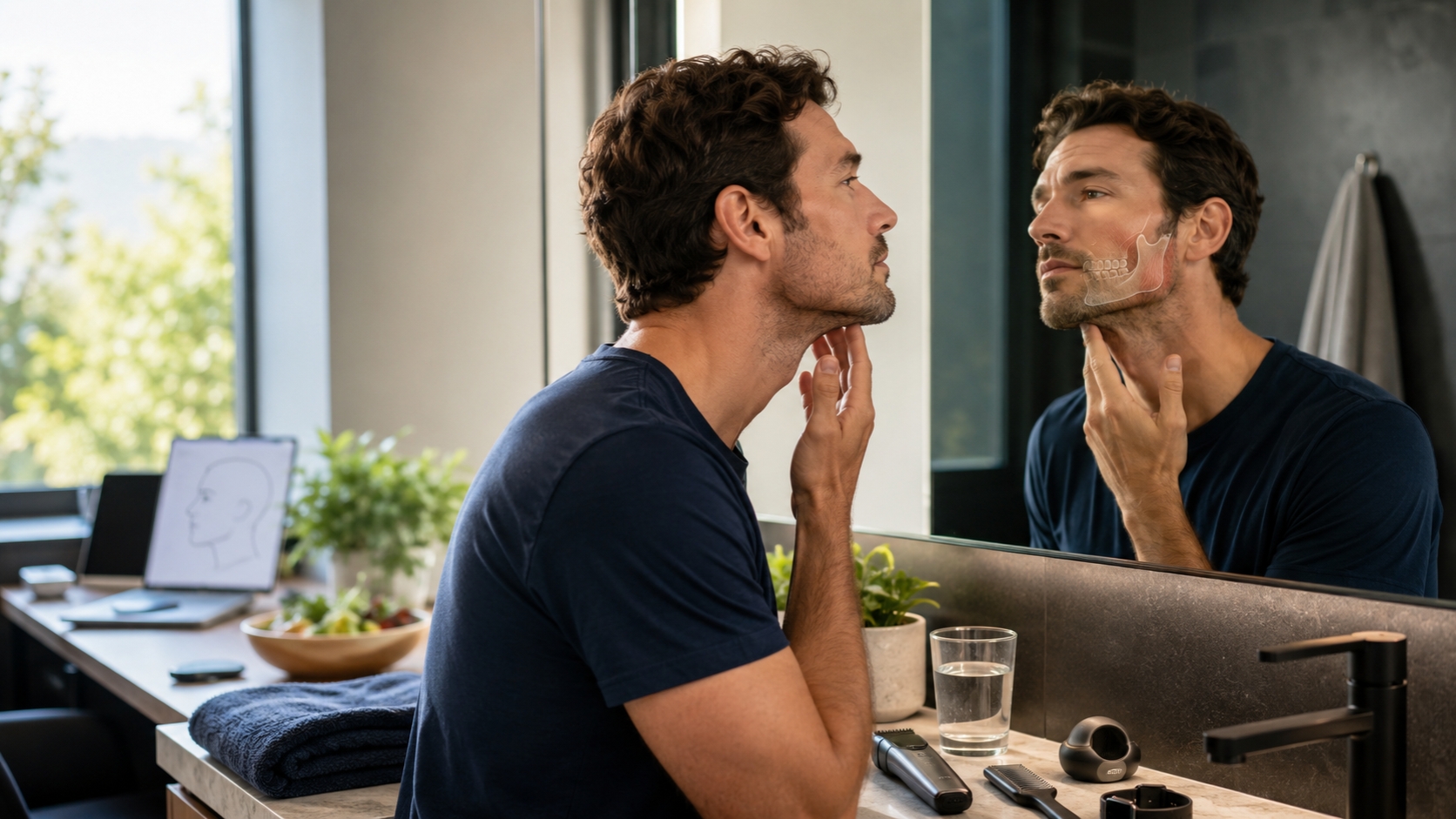
Research-based appearance guide — HealthAffPro did not physically test a jaw exerciser. Independent chewing-training and jaw-health guidance rechecked September 29, 2026. Appearance depends on several factors, and this article does not promise a device result.
For jaw anatomy, see Jaw Muscles: What They Are. For evidence about bite-resistance devices, read Do Jaw Exercisers Actually Work?
TL;DR
- Start with the cause: do not buy a jaw device before deciding whether your concern is fullness, posture, grooming, muscle size, skin, or chin structure.
- Natural options: health-appropriate body-composition changes, better posture habits, grooming, and consistent photo tracking may help appearance.
- Jaw exercises: may train chewing muscles, but cosmetic results are uncertain.[1]
- Jawzrsize: makes the most sense only for pain-free adults who specifically want jaw resistance training, not fat loss or bone reshaping.
- Jaw symptoms: pain, locking, painful clicking, reduced movement, or bite changes are reasons to stop and get professional advice.[2]
What Should You Do First?
Use a simple three-step decision path before trying exercises, supplements, or devices. The goal is to match the solution to the part of your jawline you actually want to change.
Why Isn’t My Jawline More Defined?
Jawline definition is not controlled by one muscle. The lower-face outline reflects several overlapping factors, which is why one method rarely works for everyone.
Can Bone or Chin Structure Affect Jawline Definition?
The mandible and chin create the underlying framework of the lower face. Current evidence on commercial jaw exercisers does not establish that they can rebuild adult facial bone or create a predictable skeletal contour change.[1]
Can Overall Facial Fullness Hide the Jawline?
Body composition can influence facial appearance, but people store and lose fat differently. A jaw workout is not an established way to selectively remove fat from beneath the chin.[3]
Can Bigger Jaw Muscles Make the Lower Face Look Wider?
The masseter contributes to the shape of the lower face. More muscle is not automatically the same as a sharper jawline; clinical literature on masseter hypertrophy describes a wider or squarer lower-face appearance when the muscle is enlarged.[6]
Can Skin, Posture, or Photos Change How Defined Your Jawline Looks?
Skin and soft tissue contribute to the visible jaw-to-neck outline. Posture, beard shape, camera angle, and lighting can also change how the same face appears in photos, so visual comparisons should not be treated as proof that facial anatomy changed.
What’s the Best Way to Improve Your Jawline Naturally?
Start with low-risk changes that match the cause. For most people, the practical options are overall health habits, posture, grooming, and consistent progress photos not aggressive jaw resistance.
1. Can Overall Fat Loss Make Your Jawline More Visible?
If weight loss is appropriate for your health, focus on a sustainable overall eating and activity plan rather than “face-fat” tricks. Do not use crash diets, dehydration, or excessive sweating just to make the face look temporarily leaner. Body-composition changes may affect facial appearance, but they do not let you choose exactly where fat is lost first.[3]
2. Can Better Posture Improve How Your Jawline Looks?
- Use a comfortable screen height so you are not constantly looking down.
- Use a neutral, repeatable head position when taking progress photos.
- Compare photos with the same posture instead of extending or tucking the chin differently each time.
These steps make comparisons more consistent. They should not be presented as a way to permanently reshape the jaw.
3. Can Grooming Make Your Jawline Look More Defined?
- Keep facial-hair lines intentional so beard or neck hair does not blur the jaw-to-neck boundary.
- Adjust beard length and shape to the look you prefer rather than copying one style for every face shape.
- Treat grooming as a visual change, not as a change to facial anatomy.
4. How Should You Track Jawline Changes?
Use the same camera distance, lighting, head position, facial expression, and time of day when comparing photos. This helps you separate real change from a flattering angle or different lighting.
Do Jaw Exercises Actually Help?
Jaw exercises can train chewing muscles, but current evidence does not show that commercial jaw exercisers reliably create a sharper jawline. A 2024 case report involving two users found no noticeable cosmetic improvement after about three months. Because the report included only two people, it cannot predict every user’s outcome, but it does not support guaranteed claims about double-chin reduction, skin tightening, or facial reshaping.[1]
What this means for you: jaw exercises may still provide resistance to chewing muscles, but the cosmetic outcome is uncertain. If your goal is specifically to train the jaw muscles and you are pain-free, resistance training may be something you choose to try. If your goal is fat loss, loose-skin tightening, or bone reshaping, a jaw exerciser does not match the problem.
Which Jawline Method Matches Your Problem?
Use the concern not the product as the starting point. This table is designed to help you decide what is most relevant before you spend money or start a routine.
| Your main concern | Is jaw exercise likely to help? | Better first step |
|---|---|---|
| Overall facial fullness | Limited | Health-appropriate overall body-composition approach |
| Posture or photo presentation | Not necessary | Neutral head position, screen-height changes, consistent photos |
| Weak-looking jaw musculature | Possibly | Conservative resistance training if pain-free and expectations are realistic |
| Under-chin fat | Not directly | Professional evaluation if the concern is significant or persistent |
| Loose skin | Not proven | Professional evaluation rather than stronger chewing resistance |
| Recessed or small-looking chin | No reliable structural effect | Structural assessment by an appropriately qualified professional |
| Jaw pain or TMD symptoms | Avoid self-directed training | Dentist or qualified clinician evaluation[2] |
Is Jawzrsize Worth Considering for a Sharper Jawline?
Jawzrsize is worth considering only if your goal is specifically jaw-muscle resistance training and you are pain-free. It should not be treated as a proven fat-loss, skin-tightening, or facial-bone reshaping solution. Jawzrsize product details come from the manufacturer and are not independent clinical evidence of cosmetic effectiveness.[5]
Who Might Consider Jawzrsize?
A healthy, pain-free adult who specifically wants a structured chewing-muscle workout and accepts that visible cosmetic results are uncertain.
Who Should Avoid Jawzrsize?
Someone with jaw pain, locking, painful clicking, tooth pain, bite changes, or another active jaw or dental concern should not treat a consumer resistance device as therapy.[2]
For resistance options, fit, return terms, and buying details, use the dedicated Jawzrsize review.
Read the Full Jawzrsize Review Considering Jawzrsize? Review Product Details
Who Should Avoid Jaw Training?
Avoid or stop self-directed jaw resistance if you have jaw pain, locking, painful clicking, limited movement, or bite changes. These symptoms can occur with temporomandibular disorders and are better evaluated by a dentist or another qualified healthcare professional before adding resistance.[2]
Get advice from a dentist or another qualified healthcare professional if you develop:
- Jaw locking or reduced mouth opening
- Painful clicking or popping
- Persistent jaw or face pain
- Tooth pain or unusual pressure
- A noticeable change in your bite
- Symptoms that continue after you stop training
What if the problem is under-chin fat or another structural concern?
A qualified healthcare professional can help determine whether the issue is primarily soft tissue, fat, chin structure, or something else. The FDA specifically warns against unapproved fat-dissolving injections sold online because serious adverse reactions have been reported.[4]
What Should You Check Before Starting?
Use this short checklist instead of jumping straight into the highest resistance or the most aggressive routine.
- Define the goal: less fullness, better posture, stronger-looking jaw muscles, or a structural concern.
- Use the method that can actually affect that goal.
- Take baseline photos with the same angle, distance, lighting, and head position.
- If you use jaw resistance, follow the current product instructions and stop if symptoms develop.
- Stop if jaw, tooth, bite, or movement symptoms develop.[2]
- Use a qualified professional for structural concerns, significant under-chin tissue, or persistent jaw symptoms.
Frequently Asked Questions
What is the fastest natural way to get a sharper jawline?
There is no single fast method for every cause. Grooming, posture, and consistent presentation can change appearance quickly, while health-appropriate body-composition changes take longer. Jaw exercise cannot quickly reshape adult bone or selectively remove under-chin fat.
Can jaw exercises make your jawline sharper?
They can load the chewing muscles, but current evidence does not show that commercial jaw exercises reliably reduce facial fat, tighten skin, or create dramatic facial contouring.[1]
Can losing weight make the jawline more visible?
It may if overall facial fullness is partly related to body fat, but the change varies by person. Weight loss should be gradual and appropriate for your health rather than pursued only for facial appearance.[3]
Can a jaw exerciser reduce a double chin?
Current evidence does not support jaw exercisers as a reliable way to reduce under-chin fat. A resistance device mainly loads chewing muscles rather than directly removing fat.[1]
Is Jawzrsize safe for people with TMJ?
Do not assume a consumer resistance device is appropriate if you have diagnosed or suspected TMD. Pain, locking, painful clicking, or bite changes should be evaluated before resistance training.[2]
How long does it take to notice jaw-exercise results?
There is no validated cosmetic timeline. The available evidence is too limited to promise a visible result by a specific week.[1]
What Should You Actually Do for a Sharper Jawline?
Start with the cause of the softer jawline, not with a product. Use low-risk appearance and lifestyle changes when they match the issue, consider jaw resistance only for a pain-free muscle-training goal, and seek professional evaluation when the concern appears structural or jaw symptoms are present.
What If You Want the Natural, Low-Risk Route?
Start with health-appropriate overall habits, neutral posture, grooming, and standardized progress photos. These are the most practical first steps when your concern is general appearance rather than a diagnosed structural problem.
What If You Specifically Want Jaw-Muscle Resistance?
A pain-free adult can consider conservative jaw resistance with realistic expectations. Treat it as muscle training not a proven way to remove under-chin fat, tighten skin, or rebuild facial bone.[1]
What If the Issue Looks Structural or You Have Symptoms?
Under-chin tissue, loose skin, a recessed-looking chin, jaw pain, locking, or bite changes are better reasons to seek qualified professional evaluation than to keep increasing resistance.[2]
Sources and Claim Mapping
- Verma KK, et al. Facial Contouring Through Jaw Exercises: A Report of Two Cases Examining Efficacy and Consumer Expectations. Cureus. 2024.
- National Institute of Dental and Craniofacial Research (NIDCR). Temporomandibular Disorders.
- Lei X, et al. The Influence of Body Composition Effects on Male Facial Masculinity and Attractiveness.
- U.S. Food and Drug Administration. Using Fat-Dissolving Injections That Are Not FDA Approved Can Be Harmful.
- Jawzrsize. Current product information. Manufacturer source.
- Clinical literature on bilateral masseter muscle hypertrophy and lower-face width.
 ✓
✓