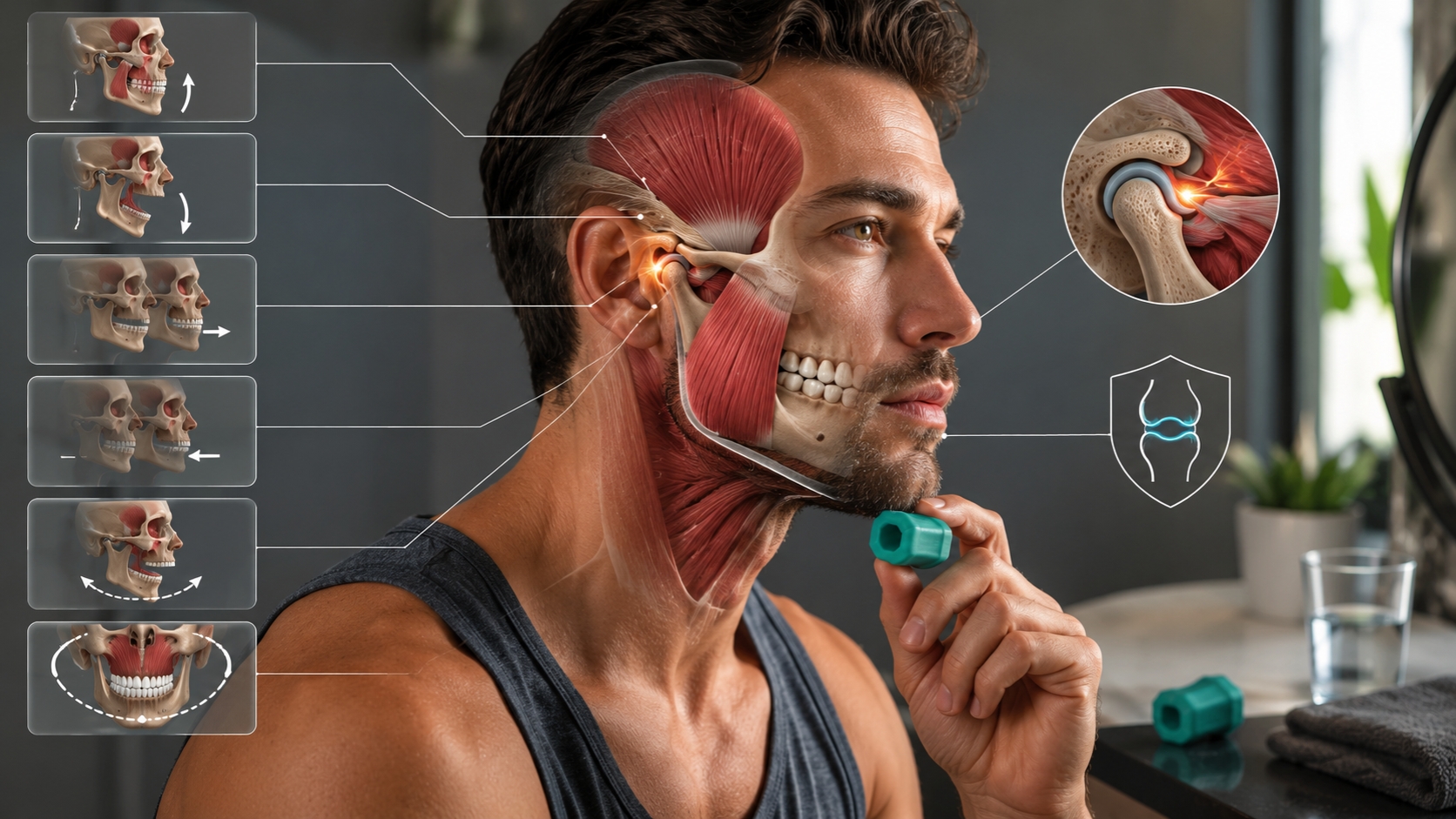
Research-based anatomy guide — HealthAffPro did not physically test a jaw-training product for this article. A 2024 chewing-training trial and NIDCR jaw-health guidance were rechecked September 29, 2026. Jaw function findings should not be treated as proof of cosmetic change from a commercial device.
For the buyer decision, read How to Get a Sharper Jawline. For the device-evidence question, see Do Jaw Exercisers Actually Work?
Your jaw does much more than move up and down. Several muscles coordinate biting, chewing, speaking, swallowing, side-to-side motion, and jaw stability—and training them does not always create the cosmetic result people expect.
TL;DR
- Main jaw muscles: masseter, temporalis, medial pterygoid, and lateral pterygoid.
- Most visible: the masseter strongly affects lower-face width and may look larger with repeated loading.
- Jaw opening: the lateral pterygoid and supporting suprahyoid muscles help lower the mandible.
- Jaw closing: the masseter, temporalis, and medial pterygoid generate most closing force.
- Training reality: resistance may strengthen chewing muscles but cannot selectively remove a double chin or reshape adult facial bones.
- Safety: avoid resistance training when you have jaw pain, locking, painful clicking, active dental concerns, or suspected TMD without professional guidance.
Quick Decision Table
| Decision point | What to know |
|---|---|
| Best for | Readers who want to understand chewing muscles before starting jaw exercises, chewing hard gum, or buying a resistance device. |
| Most visibly important muscle | The masseter, which sits on the outer side of the lower jaw and contributes to jaw width. |
| Main potential benefit of training | Greater jaw-muscle workload, endurance, coordination, or perceived strength in healthy users. |
| Main limitation | Muscle training does not directly remove facial fat, tighten loose skin, or reshape an adult mandible. |
| Skip resistance training if | You have jaw-joint pain, locking, painful clicking, tooth pain, bite changes, active orthodontic treatment, or diagnosed TMD without professional clearance. |
| Offer note | No permanent code is assumed. Check the official store for the current price, product options, terms, and available promotions. |
| Verdict | Learn which muscle and movement you are targeting before adding resistance. The hardest available device is not automatically the safest or most useful choice. |
Why Understanding Jaw Anatomy Matters Before Training
Most people do not think about jaw anatomy until they experience tightness, begin chewing unusually firm gum, or see a social-media post promising a more defined face.
The common assumption is simple: exercise makes muscles stronger, so working the jaw must create a sharper jawline. The first part is biologically reasonable. The second does not necessarily follow.
Your lower-face appearance comes from bone shape, chin projection, muscle size, facial-fat distribution, skin, age, posture, dental structure, and genetics. A resistance device mainly affects the tissues exposed to repeated loading. It cannot control every part of that system.
Understanding the muscles helps you answer a more useful question than “Does jaw training work?” The better question is: which muscle am I loading, what result could that create, and is that result appropriate for my face and jaw health?
What Are the Jaw Muscles?
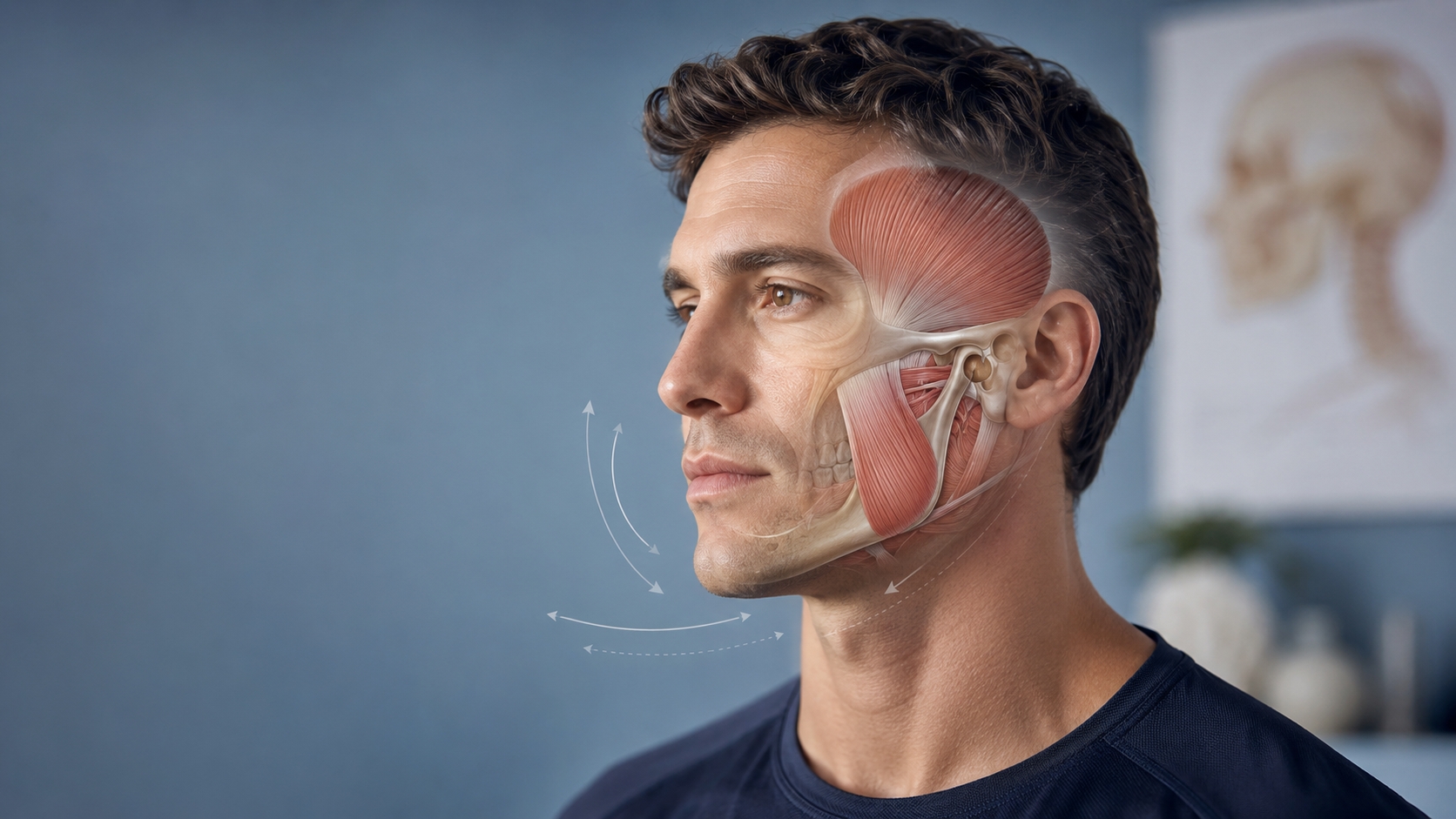
The term “jaw muscles” usually refers to the muscles of mastication—the muscles that move the mandible during biting, chewing, grinding, and related movements.
The mandible is your movable lower jawbone. Unlike the upper jaw, it must move in several directions rather than acting like a simple hinge.
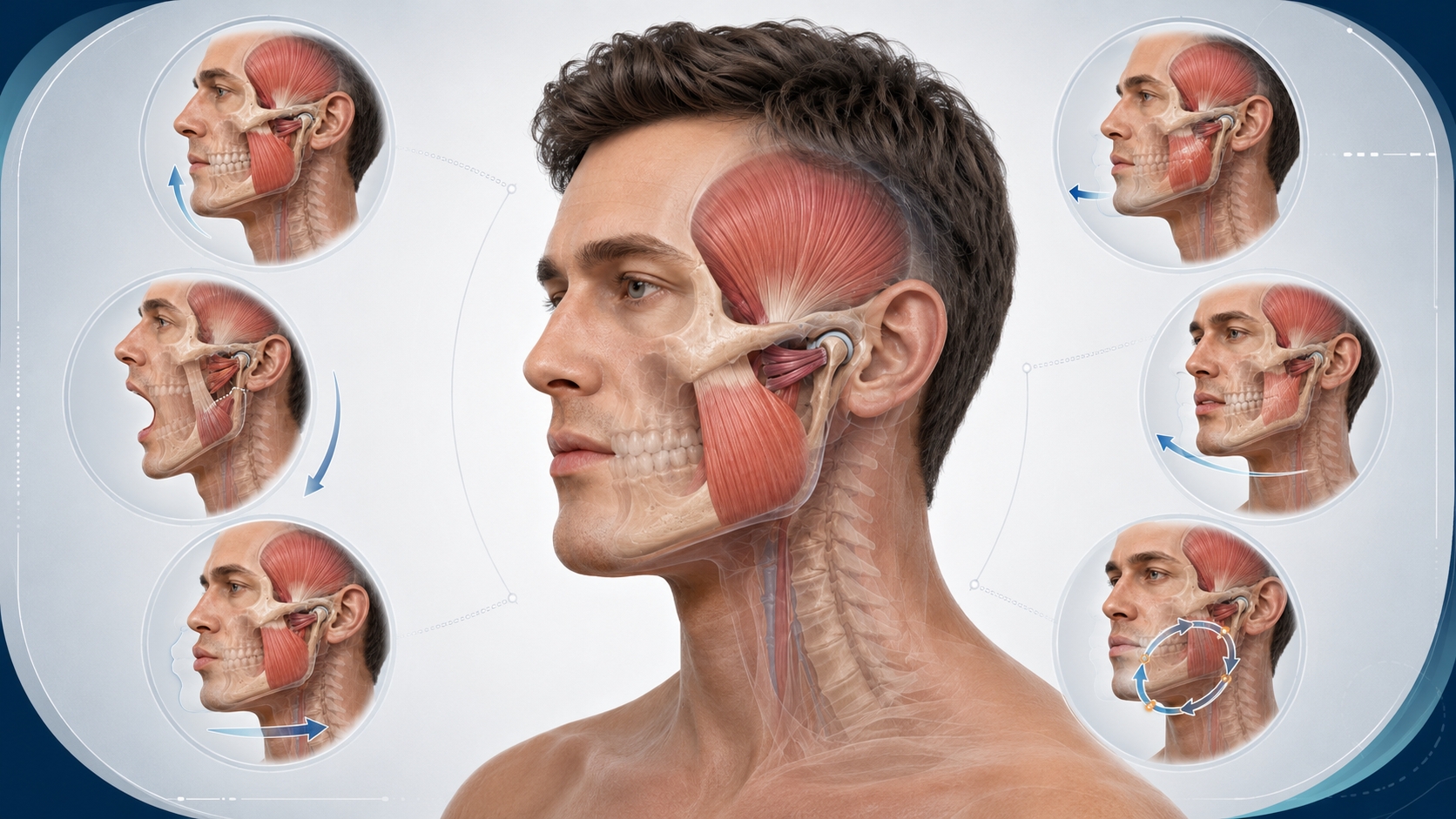
During an ordinary chewing cycle, the jaw may:
- Elevate to close the mouth
- Depress to open the mouth
- Protrude by moving forward
- Retract by moving backward
- Shift laterally for grinding
These movements require coordinated activity rather than one muscle acting alone. The masseter may produce strong closing force, but the temporalis helps position and retract the jaw. The pterygoid muscles help move it forward, open it, and create side-to-side motion.
The Four Main Muscles of Mastication
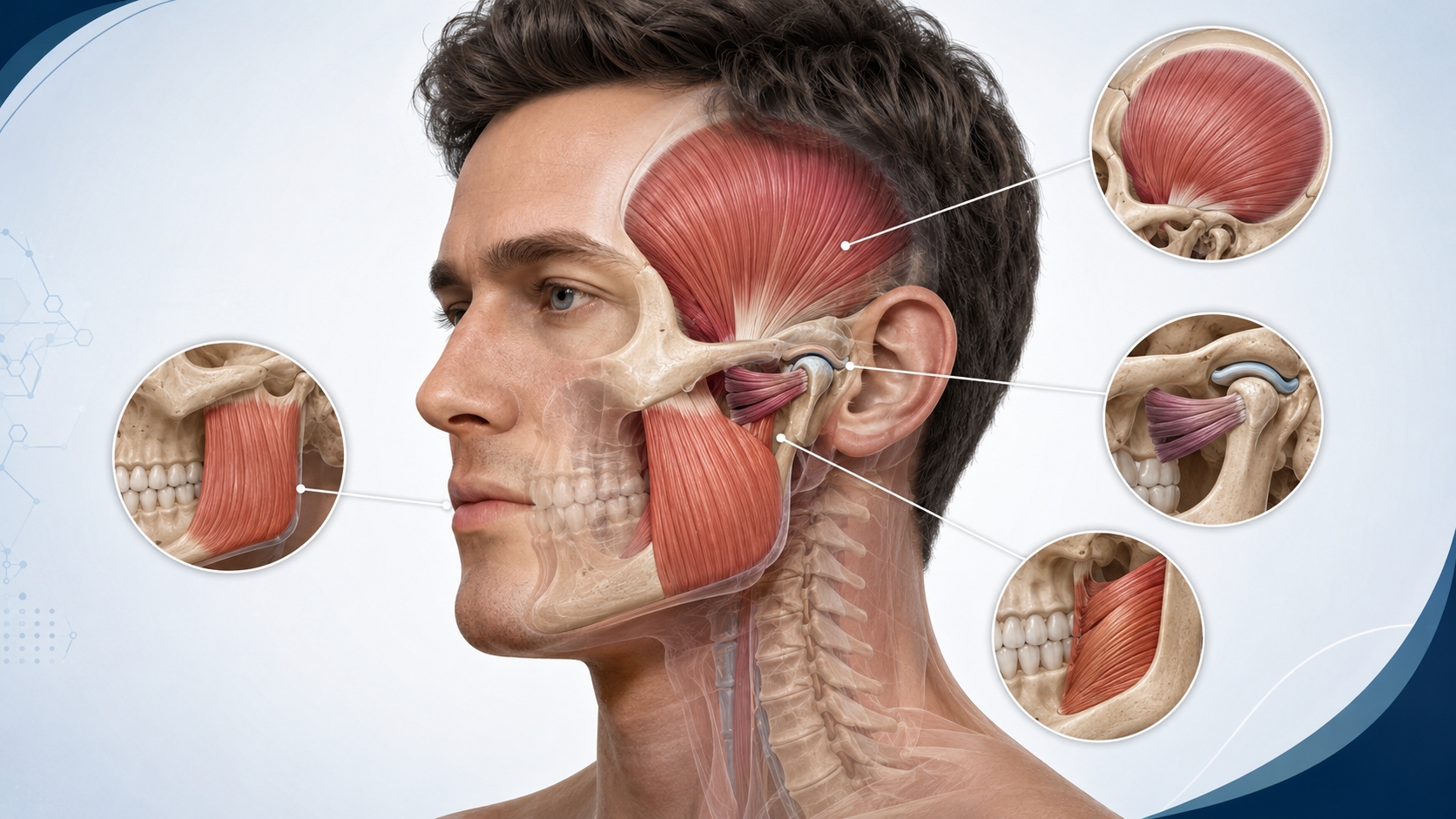
1. Masseter Muscle
The masseter is the thick, rectangular muscle you can feel at the side of your lower jaw when you clench your teeth gently. It runs from the cheekbone area to the outer surface and angle of the mandible.
Its primary job is to elevate the mandible, meaning it closes the jaw. It also contributes to forward jaw movement and produces substantial force during biting and chewing.
Because the masseter is superficial and positioned on the outer side of the jaw, changes in its size may affect visible lower-face width. A more prominent masseter may make the jaw look stronger or squarer. That is not the same as making the face narrower.
2. Temporalis Muscle
The temporalis is a broad, fan-shaped muscle located at the side of the skull above the ear. Its fibers converge toward a tendon that attaches to the mandible.
The front and middle fibers help elevate and close the jaw. The rear fibers assist with retraction, pulling the lower jaw backward after it has moved forward.
You may feel the temporalis contract by placing your fingers at your temples and gently clenching. Excessive clenching can contribute to temporal tightness or headache-like discomfort in some people.
3. Medial Pterygoid Muscle
The medial pterygoid sits deeper inside the jaw, on the inner surface of the mandibular ramus. Its position roughly mirrors the masseter on the opposite side of the bone.
It helps elevate and protrude the mandible. When one side contracts differently from the other, it also contributes to lateral movement used while grinding food.
The medial pterygoid and masseter form a muscular sling around the lower jaw. Although the medial pterygoid is not clearly visible from the outside, it is important for closing force and side-to-side control.
4. Lateral Pterygoid Muscle
The lateral pterygoid is another deep muscle located in the infratemporal region. It attaches near the mandibular condyle, joint capsule, and articular disc.
Within the four primary muscles of mastication, it is the main muscle associated with active jaw opening. It also helps move the mandible forward and contributes to lateral jaw movement.
Its relationship with the temporomandibular joint makes coordinated function important. High resistance or uncontrolled repetition should not be treated as harmless merely because the muscle is hidden from view.
| Muscle | Location | Main actions | Visible effect |
|---|---|---|---|
| Masseter | Outer side and angle of the jaw | Closes and helps protrude the jaw | May influence lower-face width |
| Temporalis | Side of the skull above the ear | Closes and retracts the jaw | Usually less visible than the masseter |
| Medial pterygoid | Deep inner side of the lower jaw | Closes, protrudes, and assists lateral movement | Not directly visible |
| Lateral pterygoid | Deep near the jaw joint | Opens, protrudes, and helps move the jaw laterally | Not directly visible |
Supporting Muscles That Help Move the Jaw
The four muscles of mastication receive most attention, but several supporting muscles help coordinate jaw opening, swallowing, cheek control, and stabilization.
Digastric
The digastric has two muscular bellies connected by an intermediate tendon. When the hyoid is stabilized, it helps depress the mandible and open the mouth.
Mylohyoid
The mylohyoid forms much of the muscular floor of the mouth. It helps elevate the floor of the mouth during swallowing and can assist jaw depression when the hyoid is fixed.
Geniohyoid
The geniohyoid lies above the mylohyoid. It helps move the hyoid forward and can assist with lowering the mandible during mouth opening.
Buccinator
The buccinator compresses the cheek and helps keep food positioned between the teeth. It supports effective chewing but is not a primary jaw-closing muscle.
Neck and hyoid muscles also provide a stable base for swallowing and mandibular movement. This is one reason jaw movement should not be reduced to “biting harder.” The surrounding system matters.
Which Jaw Muscles Create Each Movement?
| Jaw movement | Main muscles involved | Everyday example |
|---|---|---|
| Closing the jaw | Masseter, temporalis, medial pterygoid | Biting into food |
| Opening the jaw | Lateral pterygoid with digastric and other suprahyoid support | Opening the mouth to speak or eat |
| Moving forward | Lateral and medial pterygoids, with masseter assistance | Moving the lower teeth in front of the upper teeth |
| Moving backward | Posterior temporalis fibers | Returning the jaw after protrusion |
| Side-to-side grinding | Alternating pterygoid activity with coordinated closers | Grinding fibrous food |
| Cheek control | Buccinator | Keeping food between the chewing surfaces |
Which Jaw Muscle Affects Facial Appearance the Most?
The masseter has the clearest visible relationship with lower-face width because it lies close to the surface at the side and angle of the mandible.
When the masseter is naturally large—or becomes enlarged through habitual clenching, heavy chewing, or repeated loading—the lower face may look broader and more square.
That can be desirable for someone who wants a stronger, more substantial lower face. It may be undesirable for someone seeking a narrow or tapered appearance.
Jawline visibility is also affected by:
- The shape and angle of the mandible
- Chin projection
- Facial-fat distribution
- Skin thickness and elasticity
- Neck position and posture
- Beard and hairstyle choices
- Lighting, camera angle, and facial expression
Our guide on how to get a sharper jawline explains these broader factors and compares lifestyle, grooming, training, and professional options.
Can Jaw Muscles Become Stronger or Bigger?
Jaw muscles are skeletal muscles, so repeated workload can influence strength, coordination, fatigue resistance, and potentially size. That does not mean every form of jaw loading is equally useful or safe.
The response depends on factors such as:
- Current muscle size and conditioning
- Resistance level
- Session duration and frequency
- Recovery time
- Clenching or grinding habits
- Dental alignment and tooth condition
- Jaw-joint health
- Individual anatomy and genetics
Strength does not require maximum resistance
Beginners often assume that the hardest device produces the fastest result. That approach ignores the teeth, temporomandibular joints, and deeper jaw muscles that experience the same repeated forces.
A resistance level that causes uncontrolled movement, sharp pain, joint discomfort, headaches, tooth pressure, or prolonged soreness is not evidence of an effective workout.
Muscle fatigue is not the same as joint pain
Temporary muscular tiredness may occur after unfamiliar chewing activity. Sharp pain near the joint, painful clicking, locking, bite changes, or restricted opening are different warning signs.
Cosmetic results remain uncertain
A peer-reviewed two-case report examining a commercial jaw exerciser found no noticeable change in jaw appearance after approximately three months. The report also noted that the muscles targeted by these products do not directly reduce under-chin fat or tighten loose skin.
Jaw Training May
- Increase jaw-muscle workload
- Build familiarity with controlled chewing resistance
- Improve perceived endurance in some healthy users
- Increase masseter prominence over time
- Create a structured facial-fitness habit
Jaw Training Is Not Proven to
- Spot-reduce facial or under-chin fat
- Reshape an adult mandible
- Reliably tighten loose skin
- Guarantee a narrower face
- Treat TMD or bruxism
- Create identical results for every user
For a closer look at the evidence, read our research-focused guide on whether jaw exercisers actually work.
What Jaw Muscles Does Jawzrsize Work?
Jawzrsize is a silicone resistance device positioned between the upper and lower teeth. The user repeatedly compresses it by closing the jaw.
Because the movement is primarily resisted jaw closure, the masseter, temporalis, and medial pterygoid are likely to carry much of the active closing workload. The deeper jaw and stabilizing muscles may also participate in controlling the motion.
The product should therefore be viewed as a resistance tool for chewing-related muscles—not as a device that directly burns facial fat, tightens skin, or reconstructs facial bones.
Pop N Go vs Custom Fit
The official Jawzrsize site presents Pop N Go as a ready-to-use option. Custom Fit is positioned as a more specialized fitted option with a higher-resistance biting experience.
| Product factor | Potential buyer benefit | What to verify |
|---|---|---|
| Ready-to-use Pop N Go design | Less preparation before beginning | Correct size, resistance, positioning, and current instructions |
| Custom Fit option | More specialized fit and resistance experience | Fitting procedure, dental comfort, and suitability |
| Multiple resistance choices | Allows gradual progression | Do not automatically begin with the highest resistance |
| BPA-free silicone claim | Provides material information for the buyer | Check current official product specifications and care instructions |
| Portable design | Can fit into a home or travel routine | Cleaning, drying, storage, damage, and replacement |
| 60-day guarantee | Provides a defined evaluation period | Read the complete current return conditions before ordering |
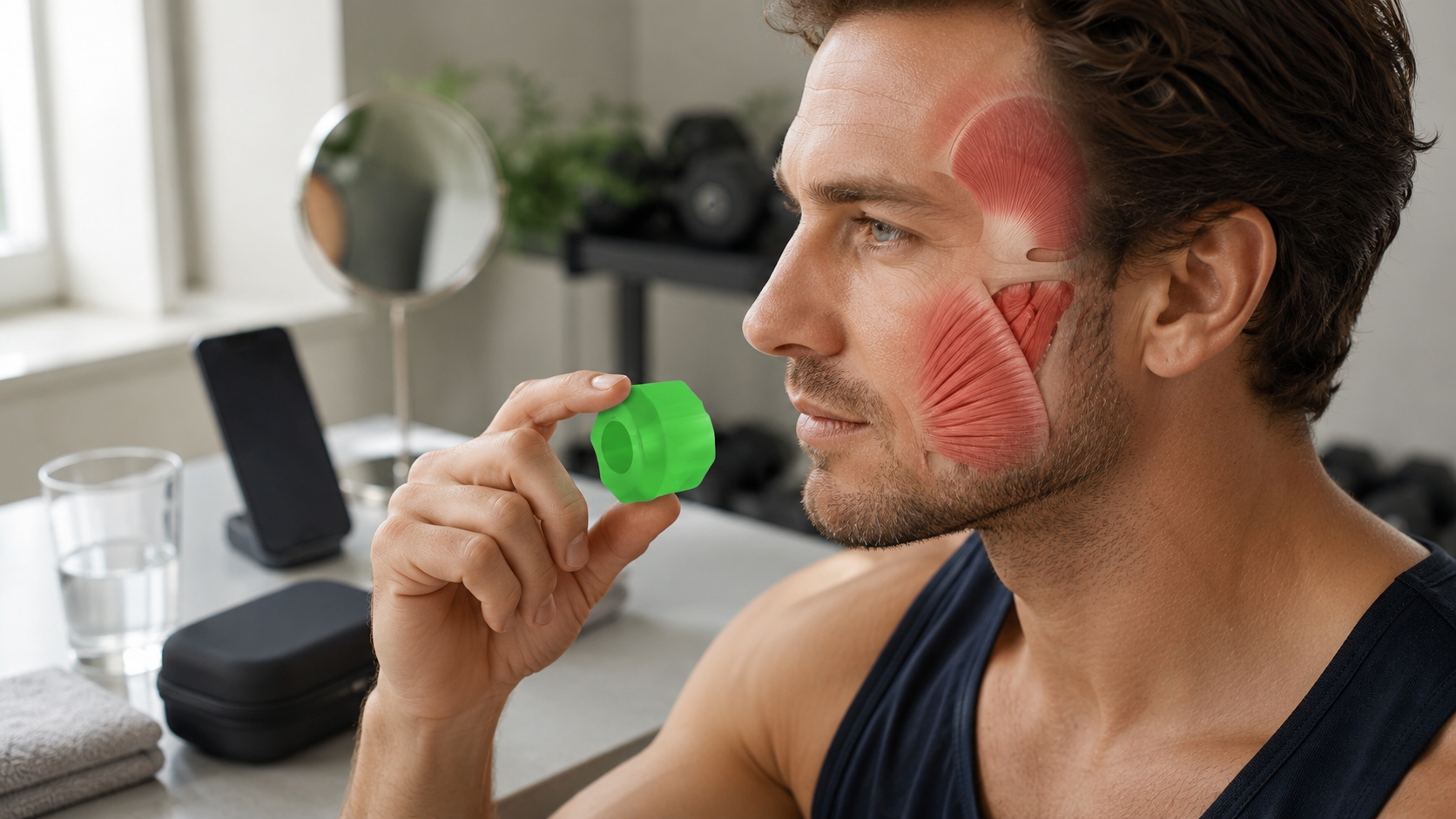
Jawzrsize may be worth considering for a healthy, pain-free adult who specifically wants structured chewing-muscle resistance and accepts that appearance changes are uncertain.
It is a poor fit for someone trying to self-treat pain, TMD, bruxism, locking, dental problems, or a double chin.
See our complete Jawzrsize review for the product’s features, drawbacks, return-policy considerations, safety issues, and full buying verdict.
Check the official website for current products, resistance options, prices, offers, instructions, and return terms.
Common Jaw-Training Mistakes
Starting with the hardest resistance
The jaw is not isolated from the teeth and joints. Excessive resistance can create forces that a beginner is not prepared to control.
Training through clicking or pain
Painful clicking, locking, restricted movement, and bite changes are not normal signs of productive muscle growth.
Using resistance to treat a medical problem
A consumer device is not a substitute for assessment of TMD, bruxism, dental pain, injury, or restricted mouth opening.
Confusing a larger masseter with facial fat loss
Muscle growth may add width beneath the skin. It does not selectively remove tissue from the cheeks or under the chin.
Clenching throughout the day
Turning ordinary resting time into constant jaw exercise can increase fatigue and reinforce unhelpful clenching habits.
Ignoring dental work
Braces, crowns, implants, sensitive teeth, loose dental work, and recent procedures may change whether resistance training is appropriate.
Signs of Jaw-Muscle Overuse
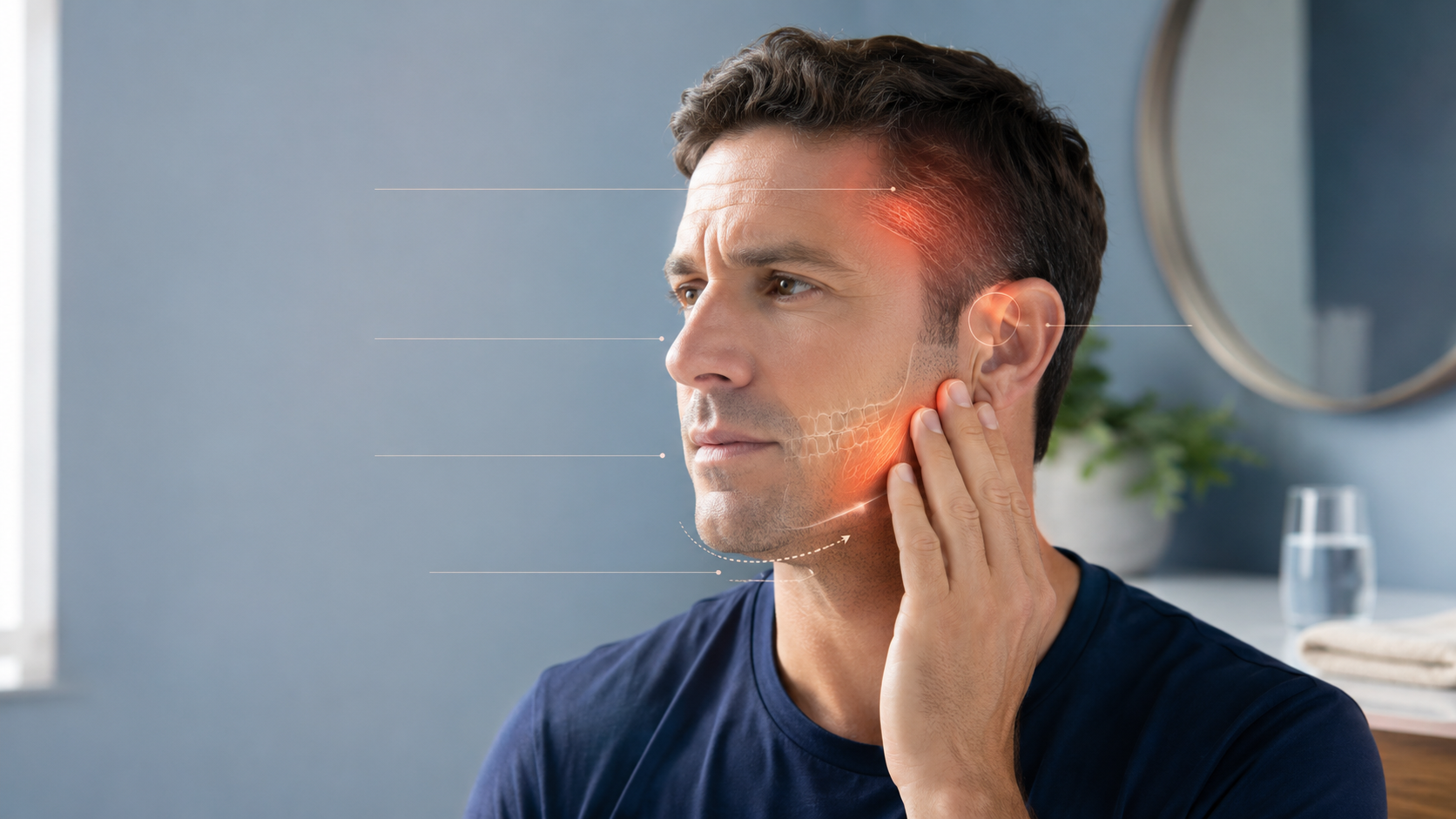
Some temporary fatigue may follow unfamiliar chewing activity. Persistent or escalating symptoms deserve more caution.
Muscular Warning Signs
- Persistent masseter soreness
- Tight temples
- Jaw fatigue during ordinary meals
- Headaches after training
- Facial tenderness
Joint or Dental Warning Signs
- Painful clicking or popping
- Jaw locking
- Reduced mouth opening
- Tooth pain or sensitivity
- A new change in the bite
NIDCR identifies chewing-muscle or jaw-joint pain, stiffness, limited movement, locking, painful joint sounds, and bite changes among possible TMD symptoms.
NIDCR also notes that bruxism can lead to tired or sore jaw muscles, tightness, headaches, facial pain, tooth damage, and sensitivity.
The M.O.V.E. Jaw-Training Checklist
M — Muscle Targeted
Identify the muscle and movement. Closing resistance mainly loads the masseter, temporalis, and medial pterygoid rather than every facial muscle equally.
O — Objective
Clarify whether you want endurance, a stronger-looking jaw, a narrower face, pain relief, or better jaw function. These goals require different approaches.
V — Volume and Resistance
Use controlled, conservative loading. More repetitions and harder resistance are not automatically more effective.
E — Existing Symptoms
Do not add resistance when pain, locking, painful clicking, bruxism, dental problems, or bite changes are already present.
- Confirm that you are not using the device to self-treat a medical or dental condition.
- Identify whether greater masseter width matches your appearance goal.
- Review your history of TMD, bruxism, headaches, tooth sensitivity, and dental work.
- Check the official fitting, positioning, cleaning, and replacement instructions.
- Begin with a manageable resistance rather than the hardest option.
- Keep jaw movements controlled and avoid aggressive clenching.
- Allow recovery instead of training through prolonged soreness.
- Stop if you develop joint pain, locking, bite changes, or tooth discomfort.
- Read the complete return policy before relying on a guarantee.
- Verify current product details and offers on the official site.
Considering a Jaw Resistance Device?
Read the full product review before selecting a resistance level. It covers Jawzrsize features, limitations, product formats, buyer objections, guarantee considerations, and who should avoid purchasing it.
Read the Full Jawzrsize Review View the Official ProductNo strength, health, or cosmetic result is guaranteed. Verify current information directly with the brand.
When to Speak With a Dentist or Healthcare Professional
Professional guidance is especially important when symptoms are persistent, worsening, or connected to jaw movement.
Seek an appropriate evaluation if you experience:
- Pain in the jaw joint or chewing muscles
- Painful clicking, popping, or grinding
- Jaw locking or limited opening
- Recurring headaches linked to clenching
- Tooth wear, cracking, sensitivity, or looseness
- Facial or neck pain
- A change in the way your teeth meet
- Symptoms following an injury or dental procedure
A dentist may assess the teeth, bite, restorations, jaw movement, muscle tenderness, and possible signs of bruxism. Depending on the concern, another clinician may also be involved.
How This Article Was Evaluated
Experience
This is an experience-style evaluation based on the way jaw-resistance products are positioned, fitted, progressed, cleaned, and used. The editorial team did not claim personal testing or personal cosmetic results.
Expertise
The evaluation considered jaw anatomy, movement, resistance direction, visible muscle effects, dental load, TMD objections, bruxism, buyer goals, product fit, and realistic alternatives.
Authoritativeness
Anatomy and safety statements were checked against the National Library of Medicine and the National Institute of Dental and Craniofacial Research. Product details were checked against the official Jawzrsize website.
Trust
Official product claims were not presented as independent proof. No rating, personal transformation, guaranteed result, medical benefit, or permanent discount was invented. Product designs, prices, promotions, policies, and availability can change.
Browse more men’s health guides or visit our men’s care product reviews for additional research and purchasing guidance.
Frequently Asked Questions
What are the four main jaw muscles?
The four main muscles of mastication are the masseter, temporalis, medial pterygoid, and lateral pterygoid. They coordinate closing, opening, forward, backward, and side-to-side jaw movement.
Which muscle closes the jaw?
The masseter, temporalis, and medial pterygoid are the principal jaw-closing muscles. The masseter produces strong elevation force, while the temporalis also helps retract the mandible.
Which muscle opens the jaw?
Within the four main muscles of mastication, the lateral pterygoid plays the central role in active opening and forward movement. The digastric, mylohyoid, and geniohyoid also assist when the hyoid is stabilized.
Which jaw muscle affects facial shape the most?
The masseter has the clearest visible effect because it lies on the outer side of the lower jaw. A larger masseter can make the lower face look stronger, wider, or squarer.
Can jaw muscles get bigger from exercise?
Repeated loading may influence muscle strength, endurance, and size. The result varies, and greater muscle size does not guarantee less facial fat or a more sharply separated jaw and neck.
What muscles does Jawzrsize work?
Its resisted closing movement primarily loads the masseter, temporalis, and medial pterygoid. Other muscles help stabilize and coordinate the jaw, but the device does not train every facial or neck muscle equally.
Can stronger jaw muscles create a sharper jawline?
They may create a more muscular or square lower face, but jawline definition also depends on bone shape, chin projection, facial fat, skin, posture, and genetics. Stronger muscles alone may not produce the intended appearance.
Can jaw training make TMJ symptoms worse?
Resistance training may aggravate symptoms in someone with jaw-joint pain, locking, painful clicking, bruxism, or dental problems. Such users should seek professional advice before beginning.
Final Takeaway
The jaw is controlled by a coordinated group of muscles rather than one isolated “jawline muscle.” The masseter, temporalis, medial pterygoid, and lateral pterygoid work together with supporting muscles to create controlled chewing and movement.
The masseter has the strongest visible relationship with lower-face width. Training it may create a more muscular or square appearance, but it cannot directly remove facial fat, tighten skin, or rebuild adult bone structure.
Jaw resistance makes the most sense for a healthy, symptom-free adult who specifically wants a structured muscle-training routine and accepts uncertain cosmetic outcomes.
Readers with pain, locking, painful clicking, tooth issues, bite changes, active dental treatment, TMD, or bruxism should not treat a consumer resistance device as a medical solution.
For a product-specific decision, review Jawzrsize’s fit, resistance options, current terms, limitations, and safety considerations before purchasing.
Read Our Jawzrsize Review Check the Official Website
Verify current products, resistance levels, prices, promotions, instructions, and return conditions before ordering.
External Sources
- National Library of Medicine. Anatomy, Head and Neck, Mastication Muscles.
- National Institute of Dental and Craniofacial Research. Temporomandibular Disorders.
- National Institute of Dental and Craniofacial Research. Bruxism.
- Verma KK, et al. Facial Contouring Through Jaw Exercises: A Report of Two Cases Examining Efficacy and Consumer Expectations. Cureus. 2024.
 ✓
✓