
Mito Red Light Reviews : Best Panel, Mini, Mat + What to Look For Before You Buy
If you’re reading Mito Red Light reviews, you want to avoid two expensive mistakes:
- You buy a device that feels too weak (or too small) for your goal.
- You buy a powerful panel… then you use it wrong, get annoyed, and quit.
This guide helps you choose the right Mito option (panel vs mini vs mat), compare Mito with popular competitors, and use a practical checklist so you don’t waste money.
Quick decision: panel vs mini vs mat (in 30 seconds)
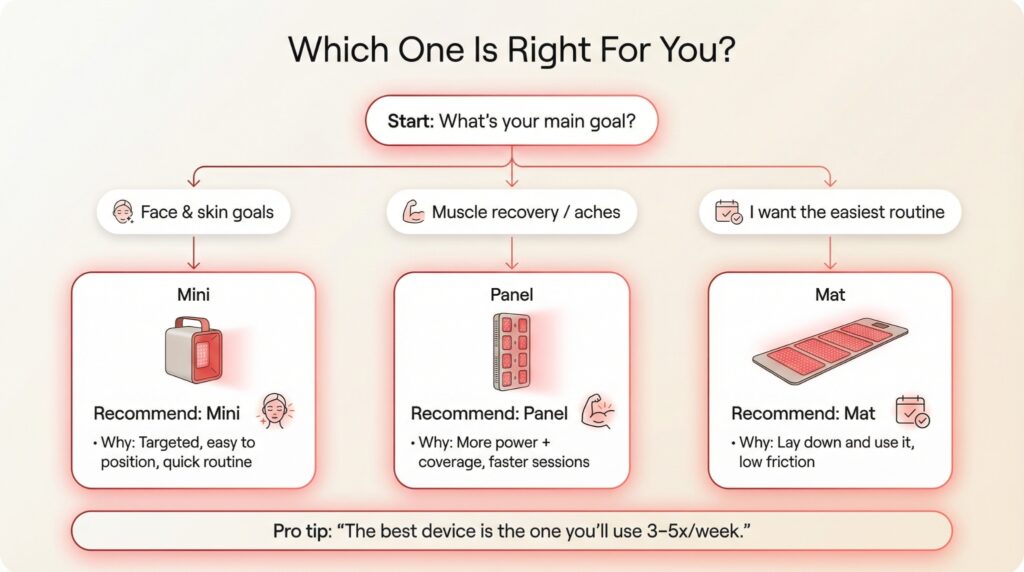
- Choose a panel if you want the best overall value and flexibility (face + body + recovery).
- Choose a mini if you mainly treat face/neck or small areas and want easier positioning.
- Choose a mat if your biggest problem is consistency and you want “lay down and use it.”
What problem are you trying to solve?
Most buyers fit into one of these buckets:
- Skin & face goals
Fine lines, texture, post-blemish marks, overall “glow.” - Recovery & body goals
Soreness, stiffness, training recovery, general wellness routine. - Convenience goals
You want something you will actually use 3–5x/week.
Keep expectations realistic
In-office red light devices often deliver higher power than home devices, so home results depend heavily on consistent use and sensible dosing. American Academy of Dermatology shares similar guidance for consumers.
Mito red light overview (panels vs mini vs mat)
1) Panels: best all-around value for most people
If you want the most “results per space and money,” start with a panel.
MitoPRO+ series (simple, strong “core wavelengths”)
MitoPRO+ focuses on four common photobiomodulation wavelengths:
- Red: 630nm / 660nm
- Near-infrared (NIR): 830nm / 850nm
Mito also publishes “irradiance at distance” numbers (commonly shown at 6 inches) and lists a 3-year warranty for the MitoPRO+ line.
Important (don’t skip this): Irradiance numbers can vary based on how a brand measures them (meter type, test setup, distance, and beam angle). Use irradiance tables for apples-to-apples comparisons only when the brand clearly states distance and method.
MitoPRO X series (more wavelengths)
If you want extra wavelength peaks, MitoPRO X lists six wavelengths:
- 590, 630, 660, 810, 830, 850nm
This line also shows irradiance-at-distance figures and generally lists a 3-year warranty (confirm on the exact model page).
MitoADAPT 4.0 (most control + widest wavelength set)
If you want the most customization, MitoADAPT 4.0 lists eight wavelengths, including:
- 590, 630, 660, 670, 810, 830, 850, 940nm
It also publishes model specs (including irradiance at a stated distance). Choose this line when you care about controls and configuration more than simplicity.
Which panel size should you choose? (simple rule)
Pick based on coverage first. You can’t “feature” your way out of the wrong size.
- Face + targeted areas: small or medium panel
- Half-body sessions: mid-size panel
- Full-body sessions: large panel or a 2-panel setup
Your “best red light therapy panel” is the one that covers enough area without turning sessions into a chore.
2) Mito mini: best for face/neck and small areas
If you mainly treat the face/neck (or one joint or small muscle group), a compact unit often wins because you can position it faster.
- You can aim it at specific spots without rearranging stands or changing your room setup.
- You tend to stay consistent because it feels simple.
Buying tip (marketplaces): If you buy through Amazon or another marketplace, confirm the official seller/store on the listing. That step helps protect your warranty and reduces authenticity issues.
3) Mito red light mat: best for low-effort daily use
Mats fit people who want “turn it on and relax” instead of standing in front of a panel.
Use the mat conservatively at first. MitoMAT guidance commonly recommends keeping sessions short and not exceeding 20 minutes per session. Start lower, track how you feel, then build a routine you can keep.
Also note: Mito positions the mat as a general wellness device, not a disease-treatment product. (That matters for how you interpret claims.)
Do red light therapy panels really work?
They can help for the right goal, but you only see results when you control two things:
- The device specs (wavelengths, distance, coverage)
- Your dosing consistency (your schedule and session habits)
What reputable sources generally agree on:
- Red light therapy can support skin appearance goals (like texture and visible signs of aging), but results vary.
- Home devices usually provide less power than professional systems, so steady routines matter more than hype.
Practical takeaway: You get better outcomes from a well-specified device and a sustainable routine than from chasing “the strongest panel” and quitting after two weeks.
Buying checklist: what to look for before you buy (Mito or any brand)
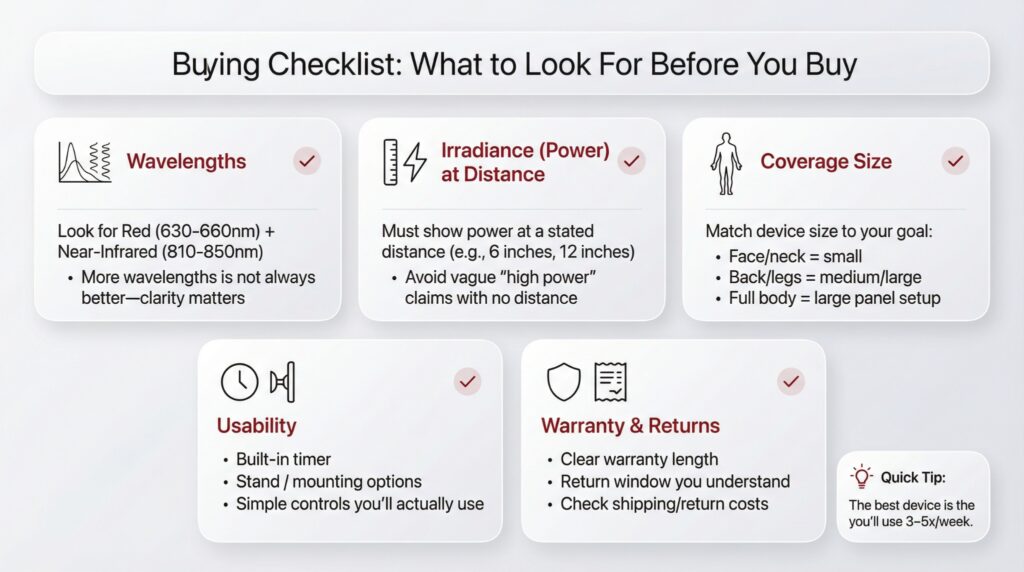
1) Wavelengths (non-negotiable)
For most home users, look for:
- Red: ~630–660nm
- NIR: ~810–850nm
MitoPRO+ keeps this simple with 630/660 + 830/850.
2) Irradiance at a stated distance (brands often get vague here)
Good listings say something like:
- “X mW/cm² at 6 inches” (or 12 inches)
Also check measurement method. Different meters and setups can change readings. Use irradiance as a comparison tool, not a promise.
3) Coverage that matches your routine
If you buy a tiny panel for full-body goals, you will likely:
- Spend forever doing sessions, or
- Stop using it
Match size to your goal first.
4) Usability that reduces friction
Look for:
- Built-in timer
- Stand / door mount / wall mount options
- Controls you will actually use
5) Warranty + returns
Warranty often varies by category:
- Panels often list longer warranties (example: 3 years on some Mito panel lines)
- Mats often list shorter warranties (example: 1 year on some mat products)
Always confirm the warranty on the exact model you’re buying.
6) Safety basics (you should take this seriously)
Use common-sense precautions:
- Don’t stare into the LEDs; protect your eyes (especially at close distance).
- Start with shorter sessions and increase gradually.
- If you take photosensitizing medications, have a medical condition, or you’re pregnant, check with a clinician before you start.
If you want to try it, you can buy through the official store and you’ll get 5% off, which makes the first order a little easier.(SHOP NOW)
FDA language: how to read claims correctly
People throw around “FDA approved” in red light marketing. Don’t let that confuse you.
- U.S. Food and Drug Administration uses different pathways (including 510(k) clearance) for certain devices and certain indications.
- FDA status varies by product and by indication. Even within one brand, some products may have clearance while others do not.
Rule: If a listing claims “FDA-cleared,” ask for the 510(k) number and the exact indication (acne, wrinkles, pain, etc.).
Mito vs competitors: comparison points that actually matter
People often compare Mito to:
- BON CHARGE
- PlatinumLED (BioMax line)
- Hooga
- Celluma
Compare like this (fast and clean)
- Wavelength set (red + NIR)
- Irradiance at a stated distance + measurement clarity
- Coverage (size)
- Controls and setup (timer/stand/mounting)
- Warranty and return policy
Quick competitor notes (keep it model-specific):
- Some brands focus on the classic 660/850 combo; others add more wavelengths.
- Some premium lines add extra NIR peaks (and sometimes independent array control).
- Some devices get attention because specific models have FDA clearance for certain uses verify the actual model and its indication.
FAQs
What is the best red light therapy panel?
The best panel is the one you use consistently and that clearly publishes:
- Wavelengths (red + NIR)
- Irradiance at a clear distance
- A size that matches your goal (face vs half-body vs full-body)
If you want a simple, “core wavelengths” approach, MitoPRO+ fits that style.
What should I look for in a red light therapy panel?
Use this checklist:
- 630–660nm + 810–850nm range
- Irradiance at a stated distance (not vague claims)
- Enough coverage for your routine
- Timer/stand/setup that reduces friction
- Warranty + returns that match the price
Strongest red light therapy at home: what does that mean?
Most people mean “higher irradiance at a stated distance.” But stronger doesn’t always mean better.
If you go too close for too long, you can irritate your skin, feel uncomfortable, or quit. You want repeatable dosing you can maintain.
Conclusion
If you want a clean buying decision:
- Choose a panel for the best overall value and flexibility.
- Choose a mini if face/neck (or a small area) is your main focus.
- Choose a mat if your biggest challenge is consistency and setup effort.