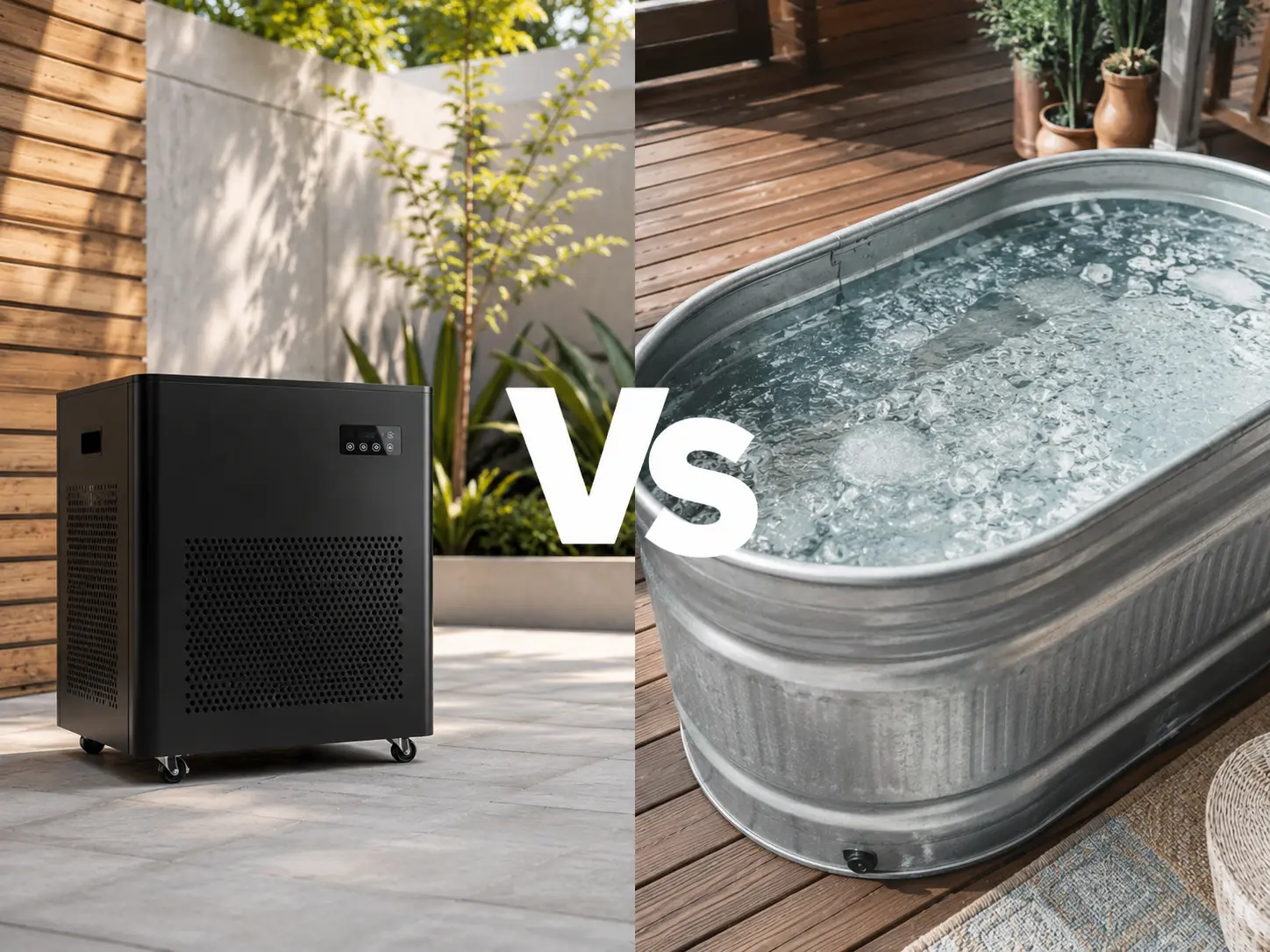
A cold plunge chiller can remove the repeated work of buying and carrying ice, but it also adds equipment cost, electricity use, water care, and maintenance. The better option depends less on advertised minimum temperatures and more on how often you plunge, what your current ice routine costs, and whether your tub and location are suitable for a chiller.
This guide compares ice, standalone chillers, and premium integrated systems. Nuvio Recovery is included as a budget-chiller case study, not as the only option available.
Quick Answer: Should You Use Ice or a Chiller?
Use ice if you are a beginner, plunge occasionally, or want the lowest financial commitment. Consider a standalone chiller if you already plunge several times per week, want predictable temperatures, own a compatible tub, and accept routine maintenance. A premium integrated system is mainly for buyers who value easier setup, stronger insulation, cleaner plumbing, and more complete water care.
| Your Situation | Likely Better Fit |
|---|---|
| You are testing whether cold plunging suits you | Ice |
| You plunge only occasionally | Ice |
| You plunge several times per week | Standalone chiller |
| You already own a compatible tub | Standalone chiller |
| You want an integrated, cleaner-looking setup | Premium cold plunge system |
| You do not want to clean filters or inspect equipment | Ice, or a higher-support integrated system |
Ice vs. Chiller: What Are the Practical Differences?
Ice has the lower upfront commitment. A chiller offers easier temperature control and less repeated preparation, but it introduces equipment, electricity, filtration, sanitation, and repair considerations.
| Factor | Ice | Water Chiller |
|---|---|---|
| Upfront cost | Low | Moderate to high |
| Recurring cost | Ice for each session | Electricity, filters, water care, and possible repairs |
| Preparation | Buying, carrying, and adding ice | Initial setup, then mostly automated cooling |
| Temperature control | Less predictable | Adjustable and repeatable |
| Water care | Water may be replaced more often | Stored water usually needs filtration and sanitation |
| Equipment risk | Minimal | Pump, filter, hose, fitting, or compressor issues are possible |
| Best suited to | Beginners and occasional users | Frequent, consistent users |
The strongest reason to buy a chiller is routine convenience, not an extreme temperature claim or a promise of dramatic health results.
How Does a Cold Plunge Chiller Work?
A cold plunge chiller uses a pump to move water from the tub through a filter and cooling unit before returning it to the tub. Once the selected temperature is reached, a thermostat-controlled unit can cycle as needed to help maintain it.
A typical setup may include:
- A tub, stock tank, bathtub, or portable pod
- A water chiller and circulation pump
- Inlet and outlet hoses, fittings, and clamps
- A debris filter
- A fitted cover
- Optional sanitation equipment or water treatment
Some systems integrate the pump and filtration. Lower-cost setups may use separate external components and require more assembly and inspection.
What Determines Cooling Speed?
Cooling speed depends on the entire setup, not horsepower alone. The main variables are:
- Starting water temperature
- Water volume
- Tub insulation and cover quality
- Ambient temperature and direct sunlight
- Airflow around the chiller
- Pump flow and filter condition
Cooling 50 gallons from 60°F to 50°F requires less work than cooling a larger tub from 75°F to 40°F. An uncovered tub in direct summer heat may also perform poorly even with a more powerful unit.
Nuvio states that its standard chiller can cool approximately 50–52 gallons from typical US tap temperatures of 55–65°F in approximately one to three hours. Its help center says a 108-gallon setup may take approximately two to six hours. These are manufacturer estimates, not guaranteed results for every environment. [3]
Nuvio also advises using a shaded or climate-controlled location when temperatures exceed 85°F and protecting the unit from direct sun, rain, snow, and freezing conditions. [4]
Is a Cold Plunge Chiller Cheaper Than Ice?
A chiller may cost less than repeated ice purchases over time, but there is no universal break-even period. The result depends on local ice prices, plunge frequency, setup cost, electricity rates, filter use, water care, and repair risk.
Total chiller ownership cost may include:
- The chiller and tub
- Pump, hoses, fittings, and clamps
- A fitted or insulated cover
- Filters and sanitation products
- Electricity
- Replacement components or repairs
- Return shipping if the setup is unsuitable
This formula is only a starting point. Add ongoing electricity, filter, water-treatment, and maintenance costs before deciding that a chiller will save money.
Keep Using Ice When:
- You are new to cold plunging
- You plunge only occasionally
- You obtain ice cheaply or free
- You do not want to store and maintain water
- You lack a shaded, ventilated location
- You are unsure whether the routine will continue
Consider a Chiller When:
- You plunge consistently several times per week
- Buying and carrying ice causes you to skip sessions
- You want water ready at a predictable temperature
- You already own a suitable tub
- Your tub can be covered or insulated
- You accept filter cleaning and basic troubleshooting
- You have reviewed the return and warranty terms
Which Cold Plunge Chiller Specifications Matter Most?
Focus on supported water volume, realistic cooling conditions, pump flow, filtration, electrical requirements, noise, warranty remedies, and replacement-part availability.
Cooling Capacity and Water Volume
Check:
- Recommended water volume
- Starting-temperature assumptions
- Expected cooling time
- Target-temperature range
- Ambient-temperature limits
- Horsepower or cooling capacity
A compact chiller may work well with a covered portable pod but struggle with a large, uninsulated stock tank in direct summer heat.
Pump, Filtration, and Water Care
Confirm:
- Whether the pump is included, integrated, or external
- Whether pump flow is suitable for the hose length and filter resistance
- What type of filter is included
- How often the filter must be cleaned or replaced
- Whether replacement filters and pumps are consistently available
- Whether ozone, ultraviolet treatment, or another sanitation method is included
A debris filter can remove visible particles, but it does not automatically make stored water sanitary.
Controls, Noise, and Electrical Requirements
App controls and schedules can improve convenience, but reliable cooling, adequate water flow, and support matter more.
Also verify:
- Voltage, frequency, and plug type
- Power consumption
- Indoor or outdoor use guidance
- Required outlet protection
- Measured noise level, when available
- Product certification and country-specific warranty support
Warranty, Returns, and Support
Read the full policy and confirm:
- Warranty duration and exclusions
- Whether the remedy is repair, replacement, or refund
- Whether a used product remains returnable
- Who pays return shipping
- Whether photos, videos, or troubleshooting steps are required
- Which support channels are available
Budget-Chiller Case Study: Nuvio Recovery
Official Product Claims
Manufacturer informationAs reviewed on July 21, 2026, Nuvio markets its standard Recovery Chiller as a 1/3 HP unit capable of cooling water to as low as 39°F. [1]
Nuvio markets its Chiller Pro as cooling to as low as 37°F and including an integrated pump, app controls, ozone cleaning, and dual filtration. These are manufacturer claims rather than independent performance verification. [2]
Customer-Feedback Patterns
Customer-reported informationAs checked on July 21, 2026, Nuvio’s Trustpilot profile displayed 327 reviews, with 45% rated five stars and 44% rated one star. [5]
The profile covers Nuvio as a company and includes several product categories, so it should not be treated as a chiller-only failure or satisfaction rate.
| Positive Themes | Negative Themes |
|---|---|
| Water remained cold as expected | Product or component failures |
| Less dependence on bags of ice | Delivery delays |
| Replacement parts were provided in some cases | Difficulty reaching support |
| Helpful assistance after reaching the right representative | Repeated troubleshooting or refund disputes |
Individual reviews can reveal recurring concerns, but they cannot establish a controlled failure rate or predict every buyer’s experience.
BBB and Policy Considerations
Third-party profile and official policyAs checked on July 21, 2026, BBB listed Nuvio with an F rating, 59 complaints, and failure to respond to 56 complaints as stated reasons for the rating. BBB also showed that Nuvio was not accredited. [6]
This is a due-diligence signal, not proof that every order or product will have a negative outcome. Buyers should review the live profile because totals and ratings may change.
Nuvio’s help center states that eligible returns must be requested within 30 calendar days of receipt and that the product must be unused, undamaged, and in its original packaging. [7]
The return instructions state that the customer is responsible for return shipping and must send an approved item back within 15 days of receiving return instructions. [8]
Nuvio also describes a one-year usability guarantee for qualifying orders and says its standard warranty approach is replacement rather than refund. [7]
Who May Find Nuvio Suitable?
Nuvio may appeal to someone who already owns a compatible tub, wants a lower entry price, and is comfortable with setup and possible troubleshooting.
It may be a weaker fit for a buyer who expects a risk-free used-product trial, effortless refunds, phone-based support, or premium-service reliability.
Considering Nuvio Recovery?
If the setup, return terms, and support expectations discussed above fit your needs, you can check the latest specifications, price, and availability. If they do not, continue comparing other chillers or keep using ice.
View Current Nuvio DetailsCold Plunge Benefits, Limitations, and Safety
What Does the Research Support?
Cold-water immersion may reduce perceived muscle soreness and support short-term recovery after strenuous exercise in some contexts. It has not been proven to deliver every medical or wellness result promoted in advertising.
A 2023 systematic review reported possible benefits for post-exercise muscle soreness and fatigue recovery, while noting that results vary by exercise type, immersion protocol, comparison method, and study design. [9]
A broader systematic review reported possible time-dependent effects on stress, sleep, and wellbeing, but also noted limited randomized evidence, small samples, and low participant diversity. [10]
A chiller should not be presented as proven to:
- Cure chronic pain or heal an injury
- Produce meaningful long-term fat loss
- Treat depression or prevent disease
- Increase lifespan
- Guarantee better sleep
- Permanently reduce inflammation
Research on cold-water immersion is not product-specific proof for Nuvio or any other chiller brand.
Is Cold Plunging Safe for Everyone?
No. Sudden cold-water immersion can trigger a cold-shock response that affects breathing and cardiovascular function. Research describes risks including hyperventilation, cardiac rhythm disturbances, loss of coordination, hypothermia, and drowning. [11]
Seek medical guidance before starting if you have a condition that may be affected by sudden cold exposure, including cardiovascular disease, uncontrolled high blood pressure, fainting history, circulation problems, serious respiratory disease, pregnancy, or another relevant condition.
Beginners should:
- Avoid starting at the coldest available setting
- Enter slowly and keep the head above water
- Avoid deliberate breath-holding
- Avoid plunging alone
- Exit if breathing becomes uncontrollable
- Stop for chest discomfort, dizziness, confusion, or unusual weakness
Cold Plunge Chiller Buying Checklist
| Area | What to Check |
|---|---|
| Routine | Weekly use, current ice cost, preferred temperature, and likely long-term use |
| Tub | Water capacity, insulation, lid, drainage, and hose compatibility |
| Location | Shade, airflow, weather protection, flooring, drainage, and electrical safety |
| Cooling | Supported volume, starting-temperature assumptions, target temperature, and ambient limits |
| Pump and filter | Flow rating, included components, cleaning schedule, and replacement availability |
| Water care | Sanitation method, treatment requirements, and ongoing supply cost |
| Electrical | Voltage, plug, power use, certification, and outlet requirements |
| Returns | Used-product eligibility, deadline, packaging rules, shipping cost, and fees |
| Warranty | Duration, exclusions, evidence requirements, and repair, replacement, or refund remedy |
| Support | Available contact channels, manuals, response expectations, and troubleshooting process |
Final Decision: Ice, Standalone Chiller, or Premium System?
Choose Ice If:
You are a beginner, plunge occasionally, want the lowest commitment, or do not want to maintain stored water and cooling equipment.
Choose a Standalone Chiller If:
Cold plunging is already part of your routine, ice preparation is inconvenient, and you have a compatible tub, safe location, and willingness to perform basic maintenance.
Choose a Premium Integrated System If:
You value easier setup, stronger insulation, cleaner plumbing, more complete water care, and higher support expectations more than a low purchase price.
A budget chiller such as Nuvio sits between ice and a premium integrated system. Its lower entry price should be weighed against realistic cooling conditions, component quality, maintenance, return restrictions, warranty remedies, and customer-support patterns.
The first decision is not which brand to buy. It is whether a chiller solves your current problem better than ice.
Frequently Asked Questions
Do I need a chiller for a cold plunge?
No. Ice is sufficient for occasional use. A chiller mainly adds convenience, adjustable temperature control, and less dependence on repeated ice purchases.
How powerful should a cold plunge chiller be?
Choose based on water volume, starting and target temperatures, insulation, ambient heat, and pump flow. Horsepower alone does not predict real-world performance.
How long does a cold plunge chiller take to cool water?
Cooling may take several hours. The exact time depends on water volume, starting temperature, insulation, ambient temperature, airflow, and pump performance.
Is a cold plunge chiller cheaper than ice?
It may be cheaper for frequent users, but there is no universal break-even period. Include purchase cost, electricity, filters, water treatment, maintenance, and repairs.
Can a cold plunge chiller stay outdoors?
Some models can operate outdoors when properly protected. Direct sun, rain, snow, extreme heat, and freezing temperatures may reduce performance or damage equipment, so follow the instructions for the specific model.
What should I check before ordering?
Check tub compatibility, supported water volume, cooling assumptions, pump and filtration details, electrical requirements, replacement parts, total ownership cost, return eligibility, warranty remedies, and support.
Sources and Further Reading
- Nuvio Recovery: Recovery Chiller product page
- Nuvio Recovery: Recovery Chiller Pro product page
- Nuvio Help Center: How Long to Chill the Water?
- Nuvio Help Center: Can the Chiller Be Used Outdoors?
- Trustpilot: Nuvio Recovery customer-review profile
- Better Business Bureau: Nuvio business profile
- Nuvio Help Center: Warranty, Refunds and Returns
- Nuvio Help Center: How Do I Request a Return?
- Xiao et al., 2023: Effects of cold-water immersion after exercise on fatigue recovery
- Cain et al., 2025: Effects of cold-water immersion on health and wellbeing
- Shattock and Tipton: Autonomic conflict and cold-water submersion risk
 ✓
✓