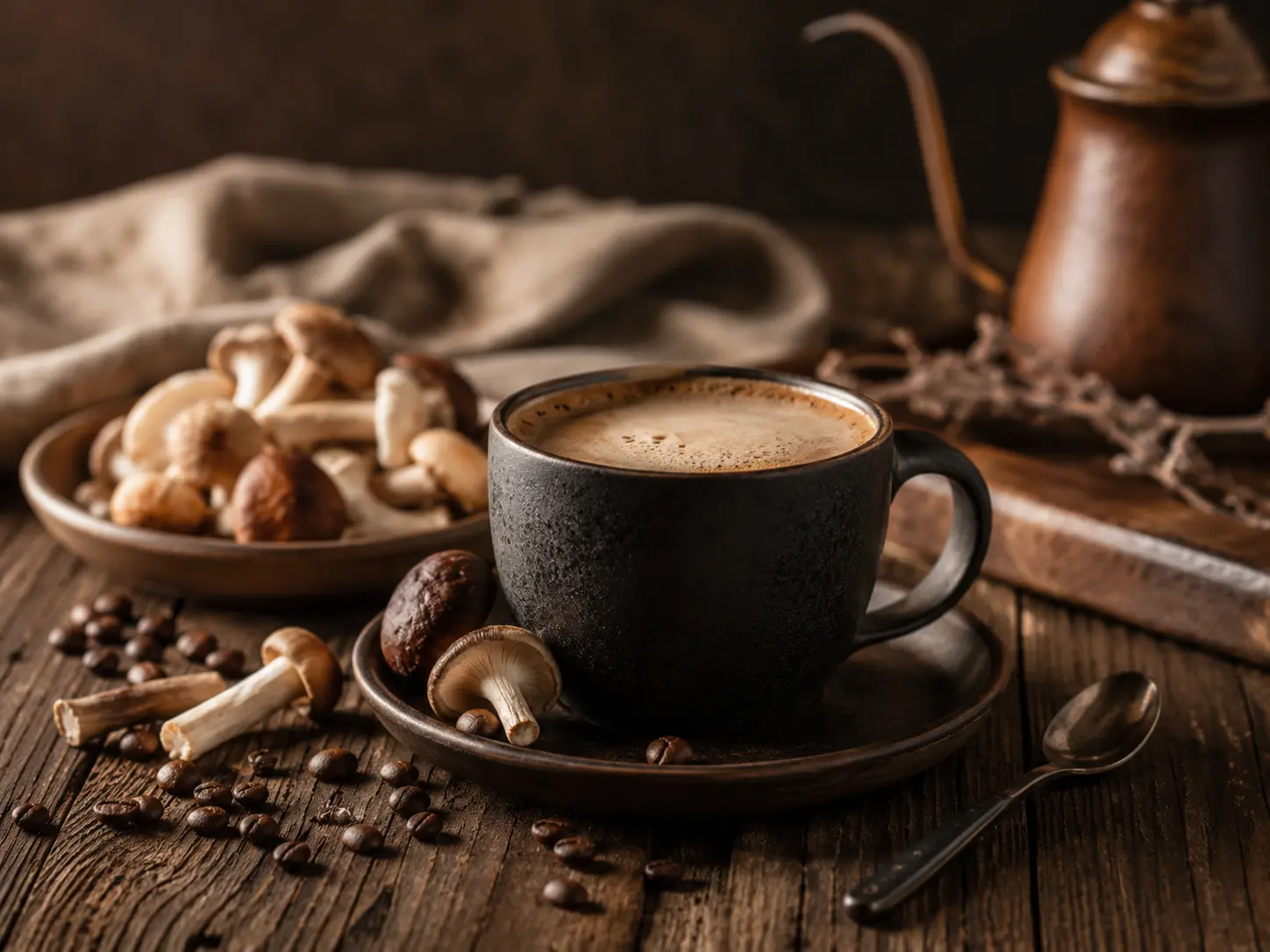
Mushroom coffee is coffee or a coffee-style drink mixed with mushroom powders or extracts such as lion’s mane, cordyceps, reishi or chaga. If it contains caffeine, caffeine is the part most clearly associated with short-term alertness. Human research on mushroom extracts is still mixed and does not show that every commercial mushroom coffee improves focus, energy, immunity or stress. [1] [2] [3]
For most buyers, the useful questions are practical: how much caffeine does it contain, what else is in the formula, are ingredient amounts clearly disclosed, how does it fit your diet, and is the higher price worth it to you?
- Want less caffeine? Compare the actual caffeine amount per serving.
- Interested in the mushrooms? Check the specific ingredients and disclosed amounts.
- Take medication, are pregnant or breastfeeding? Evaluate the complete formula rather than the coffee portion alone.
What exactly is mushroom coffee?
Mushroom coffee is usually coffee or another beverage base combined with one or more mushroom extracts or powders. It does not normally mean pieces of culinary mushrooms added to brewed coffee.
Products can also contain cacao, chicory, matcha, creamers, sweeteners, vitamins, L-theanine or herbal ingredients such as ashwagandha. This is why the complete ingredient list matters more than the phrase “mushroom coffee.”
How does mushroom coffee actually work?
There is no single effect shared by every mushroom coffee because formulas differ. The clearest way to evaluate one is to separate its caffeine from its other ingredients.
The FDA notes that caffeine sensitivity varies substantially between individuals. For most adults, the FDA cites 400 mg per day as an amount not generally associated with negative effects, but this is not a target and some people experience unwanted effects at much lower intakes. [1]
Does mushroom coffee really improve focus or energy?
There is not enough consistent evidence to say that mushroom coffee itself reliably improves focus or energy beyond effects that may come from caffeine.
Lion’s mane has been tested in human studies, but results are not consistent. A 2023 randomized pilot trial reported some positive signals alongside many outcomes without significant improvement, while a 2025 placebo-controlled study found no significant overall improvement in cognition or mood. [2] [3]
Cordyceps research is also mixed. One controlled trial reported changes in selected exercise measures, while another found no improvement in endurance exercise performance. [4] [5]
What the evidence covers: Specific mushroom preparations, doses and study populations.
What it does not prove: That every commercial mushroom coffee provides the same effect.
How strong is the evidence behind common mushroom-coffee claims?
The evidence is strongest for caffeine-related alertness and much less certain for broad mushroom-coffee wellness claims.
These labels are editorial summaries of the cited research. They are not FDA, NIH or formal clinical evidence grades.
Does mushroom coffee taste like mushrooms?
Not necessarily—the taste depends on the full formula. Coffee-based products may taste mainly like coffee, while formulas containing cacao, chicory, spices, creamers or sweeteners can taste very different.
Mushroom extracts can add earthy or slightly bitter notes, but there is no single “mushroom coffee taste.” Texture can also vary between brewed coffee and instant powdered blends.
How do you make mushroom coffee?
Follow the product directions because mushroom coffee can be sold as instant powder, ground coffee or a latte-style mix.
-
Use the labeled serving size.
Avoid adding extra scoops simply because you want a stronger effect. -
Add the recommended amount of water.
Preparation amounts differ between products. -
Stir, shake or froth thoroughly.
Instant powders and creamer-containing blends may need more mixing than ordinary brewed coffee. -
Add milk or sweetener only if you want it.
Remember that additions can change the drink’s calories, sugar and other nutrition values.
Can you drink mushroom coffee hot or iced?
Usually, yes, if the product’s preparation instructions allow it. Instant powders that do not dissolve well in cold liquid can first be mixed with a small amount of warm water before adding ice or cold milk.
Is mushroom coffee healthier than regular coffee?
Not automatically. Adding mushroom extracts does not by itself make a drink healthier than regular coffee.
| What to Compare | Mushroom Coffee | Regular Coffee |
|---|---|---|
| Caffeine | Varies by formula. | Usually present unless decaffeinated. |
| Extra ingredients | Often mushrooms and sometimes herbs, vitamins or creamers. | Plain coffee is generally simpler unless ingredients are added. |
| Added sugar | Depends on the product. | Depends on what you add. |
| Mushroom-related benefit | Depends on the ingredient and evidence; not guaranteed. | Not applicable. |
| Cost | Compare the actual price per full serving. | Compare using the same per-serving calculation. |
Can mushroom coffee cause side effects?
Yes. Possible problems can come from caffeine, mushrooms or other ingredients added to the blend.
- Caffeine: too much for your individual tolerance can contribute to symptoms such as poor sleep, anxiety, jitters, increased heart rate, headache or stomach upset. [1]
- Reishi: Memorial Sloan Kettering advises caution with anticoagulant or antiplatelet medicines and immunosuppressants. [6]
- Chaga: published case reports have linked substantial or long-term intake with oxalate-related kidney injury. [7] [8]
- Added herbs: ingredients such as ashwagandha have their own precautions and medication interactions. [11]
Who should check with a healthcare professional before drinking it regularly?
People taking certain medications, pregnant or breastfeeding people, and people with kidney disease, significant caffeine sensitivity or mushroom allergies should get individualized advice before regular use.
The exact concern depends on the product because mushroom coffees can contain different amounts of caffeine, multiple mushroom extracts and additional herbs or supplements.
What about pregnancy?
Pregnancy requires looking at both caffeine intake and the rest of the formula. ACOG states that moderate caffeine consumption below 200 mg per day does not appear to be a major contributor to miscarriage or preterm birth, but that guidance does not establish the safety of every mushroom extract or added herb. [9]
What about breastfeeding?
Caffeine passes into breast milk, so total daily intake still matters. CDC describes about 300 mg per day or less as low-to-moderate maternal caffeine intake that usually does not adversely affect the infant. Very high intake has been associated with infant fussiness, poor sleep and jitteriness. [10]
Added herbal ingredients should be considered separately. For example, NCCIH advises that ashwagandha should not be used while breastfeeding. [11]
Is chaga in mushroom coffee bad for your kidneys?
Normal use has not been shown to damage everyone’s kidneys, but high or prolonged chaga intake is a legitimate safety concern.
Published case reports describe oxalate-related kidney injury after substantial or long-term chaga consumption. Case reports do not tell us how common the problem is and do not prove that every ordinary chaga-containing beverage causes kidney damage. [7] [8]
What should you look for on a mushroom-coffee label?
Check caffeine, serving size, the complete ingredient list, nutrition information and ingredient transparency before buying.
- Caffeine per serving: check the milligram amount when the manufacturer provides it.
- Serving size: confirm whether one serving means one scoop, packet or brewed cup.
- Calories and added sugar: especially important with flavored or latte-style blends.
- Creamers and allergens: check ingredients such as milk, coconut or soy if relevant to you.
- Mushroom ingredients: identify which mushrooms are actually included.
- Ingredient amounts: individual amounts are easier to evaluate than one combined proprietary-blend number.
- Other herbs or supplements: check for adaptogens and additional active ingredients.
- Quality testing: look for recognizable third-party certification or useful batch-testing information rather than relying only on the phrase “lab tested.”
- Subscription terms: check renewal, cancellation and refund conditions before buying.
Is every mushroom coffee a dietary supplement?
No. In the United States, liquid products can be marketed as conventional beverages or as dietary supplements depending on factors including their labeling and intended use. [12]
For products marketed as dietary supplements, FDA does not approve them for safety and effectiveness before marketing in the same way it approves drugs. [13]
What does useful third-party testing tell you?
Third-party certification can provide information about product quality, but it does not prove a health benefit. NSF and USP verification programs focus on issues such as ingredient identity, label accuracy, manufacturing quality and contaminants within the scope of their programs. [14] [15]
How should you compare mushroom-coffee prices?
Compare price per full serving rather than package price or introductory subscription offers.
Package price ÷ number of full servings = cost per serving
Then compare that figure with what you currently spend on coffee. This keeps the decision useful even when brand prices, sales and subscription discounts change.
Is mushroom coffee worth paying more for?
It may be worth trying if you like the formula, taste and convenience, but paying more does not mean the health benefits are better proven.
| It May Make Sense If… | Think Twice If… |
|---|---|
| You enjoy the taste and preparation style. | You are buying mainly because of dramatic wellness promises. |
| The caffeine level fits your routine. | The caffeine amount is unclear and caffeine matters to you. |
| Important ingredients are transparently listed. | The formula hides most ingredients inside a proprietary blend. |
| The price per serving fits your budget. | You mainly want a simple, inexpensive source of coffee and caffeine. |
Frequently asked questions about mushroom coffee
Does mushroom coffee actually contain coffee?
Some products contain regular or instant coffee, while others use chicory, cacao or another coffee-style base. Check the ingredient list because there is no single standardized mushroom-coffee formula.
Does mushroom coffee have less caffeine than regular coffee?
Sometimes, but not always. The useful comparison is the caffeine amount per serving rather than the words “mushroom coffee” on the package.
Does mushroom coffee taste like mushrooms?
Not necessarily. Flavor depends on the coffee or beverage base plus ingredients such as cacao, chicory, spices, creamers and sweeteners. Some formulas may have an earthy or slightly bitter note.
Can you drink mushroom coffee iced?
Usually, if the product instructions allow it. Instant powder can be dissolved first and then combined with ice, water or milk.
Can I drink mushroom coffee every day?
There is no one answer for every product or person. Regular use depends on the caffeine amount, mushroom ingredients, added herbs, medications and your health situation.
Is mushroom coffee better than regular coffee?
Not universally. Regular coffee is simpler if you mainly want coffee flavor and caffeine. Mushroom coffee adds other ingredients, but those additions do not automatically make it healthier or more effective.
So, is mushroom coffee actually worth trying?
Mushroom coffee can be a reasonable drink to try, but it should not be treated as a proven treatment or guaranteed health upgrade. If it contains caffeine, caffeine provides the clearest predictable short-term effect. Research on mushroom extracts remains ingredient- and preparation-specific.
Before buying, compare caffeine, the complete ingredient list, nutrition information, mushroom amounts, added herbs, quality-testing information, price per serving and subscription terms. If you take medication, are pregnant or breastfeeding, or have kidney or allergy concerns, evaluate the specific formula with an appropriate healthcare professional.
Sources & Research — View References
Research on individual mushroom ingredients is not presented as proof that every finished mushroom-coffee product provides the same effect.
- U.S. Food and Drug Administration. “Spilling the Beans: How Much Caffeine is Too Much?” FDA .
- Docherty S, Doughty FL, Smith EF. “The Acute and Chronic Effects of Lion’s Mane Mushroom Supplementation on Cognitive Function, Stress and Mood in Young Adults.” PubMed .
- Surendran G, et al. “Acute effects of a standardised extract of Hericium erinaceus on cognition and mood in healthy younger adults.” PubMed .
- Chen S, et al. “Effect of Cs-4 (Cordyceps sinensis) on exercise performance in healthy older subjects.” PubMed .
- Parcell AC, et al. “Cordyceps Sinensis supplementation does not improve endurance exercise performance.” PubMed .
- Memorial Sloan Kettering Cancer Center. Reishi Mushroom. MSKCC .
- Kwon O, et al. “Chaga mushroom-induced oxalate nephropathy.” PubMed .
- Lee S, et al. “Development of End Stage Renal Disease after Long-Term Ingestion of Chaga Mushroom.” PubMed .
- American College of Obstetricians and Gynecologists. “Moderate Caffeine Consumption During Pregnancy.” PubMed .
- Centers for Disease Control and Prevention. “Maternal Diet and Breastfeeding — Caffeine.” CDC .
- National Center for Complementary and Integrative Health. “Ashwagandha: Usefulness and Safety.” NCCIH .
- U.S. Food and Drug Administration. “Distinguishing Liquid Dietary Supplements from Beverages.” FDA .
- U.S. Food and Drug Administration. “Questions and Answers on Dietary Supplements.” FDA .
- NSF. Dietary Supplement and Vitamin Certification. NSF .
- United States Pharmacopeia. Dietary Supplement Verification Program. USP .
 ✓
✓