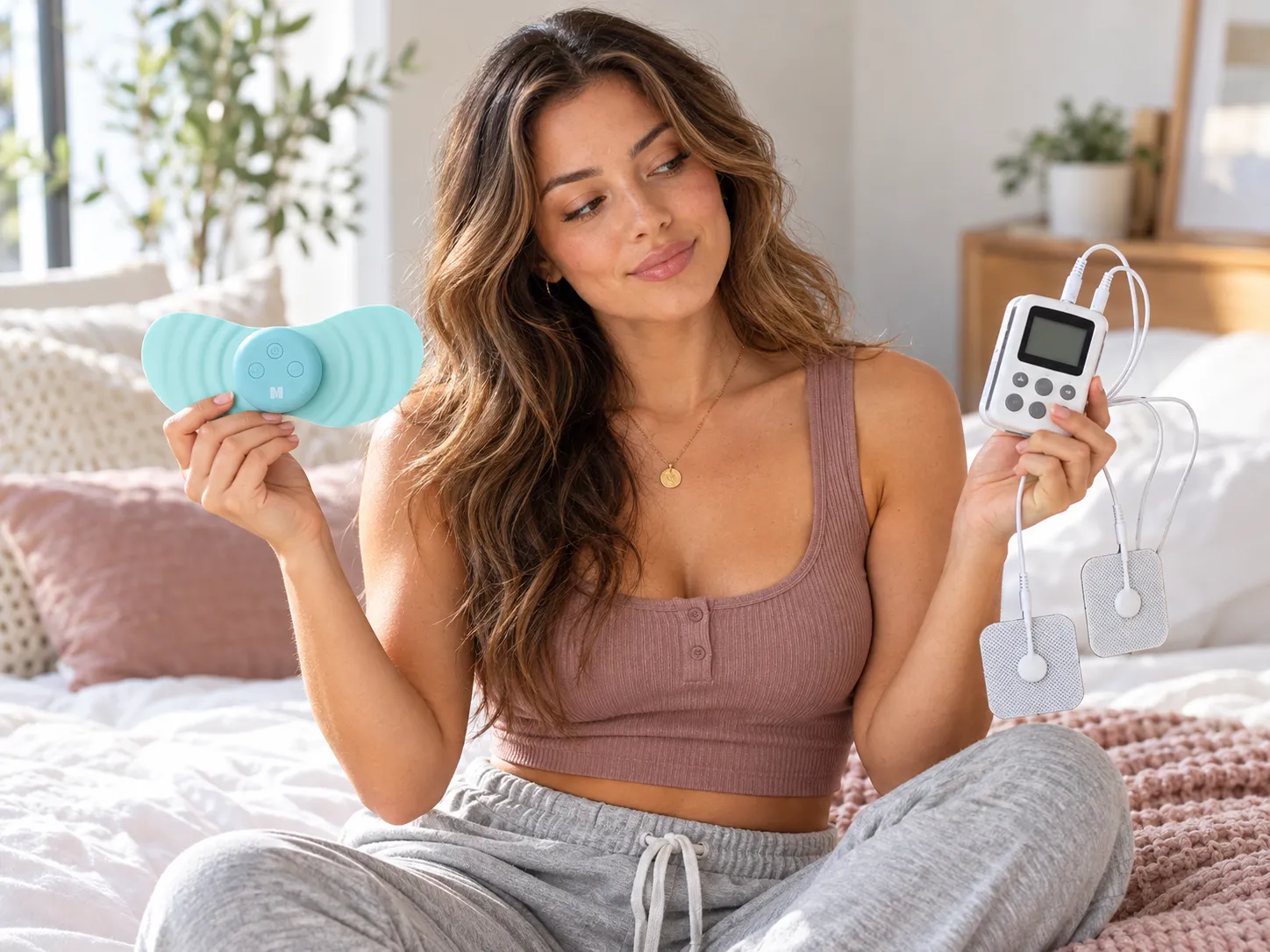
You are already looking at TENS for period pain. Then Myoovi 2.0 appears at £79.99, while standard TENS machines can cost much less. That changes the question from “does TENS help?” to “what am I actually paying extra for with Myoovi?” [1]
This comparison focuses on that buying decision: pain-relief evidence, heat, portability, controls, replacement-pad costs, reported Myoovi 2.0 problems and whether its convenience is genuinely useful enough to justify the premium.
If you want the broader product-level verdict before comparing it with a standard TENS machine, read our Myoovi Review 2026 for effectiveness evidence, 2.0 complaints, ownership costs and who the device makes the most sense for.
If your bigger question is irregular-cycle timing rather than pain relief, our guide to tracking ovulation with irregular periods covers app predictions, LH tests, BBT and PdG as a separate tracking problem.
Quick Verdict
Myoovi 2.0 makes the most sense when wireless wear, built-in heat and a compact period-focused setup solve a real convenience problem for you. A regular TENS machine makes more sense if your main goal is electrical stimulation at a lower cost and you do not mind wires or a less discreet setup.
The evidence reviewed here does not establish that Myoovi provides stronger pain relief than conventional TENS. Its strongest value argument is convenience rather than proven superior stimulation.
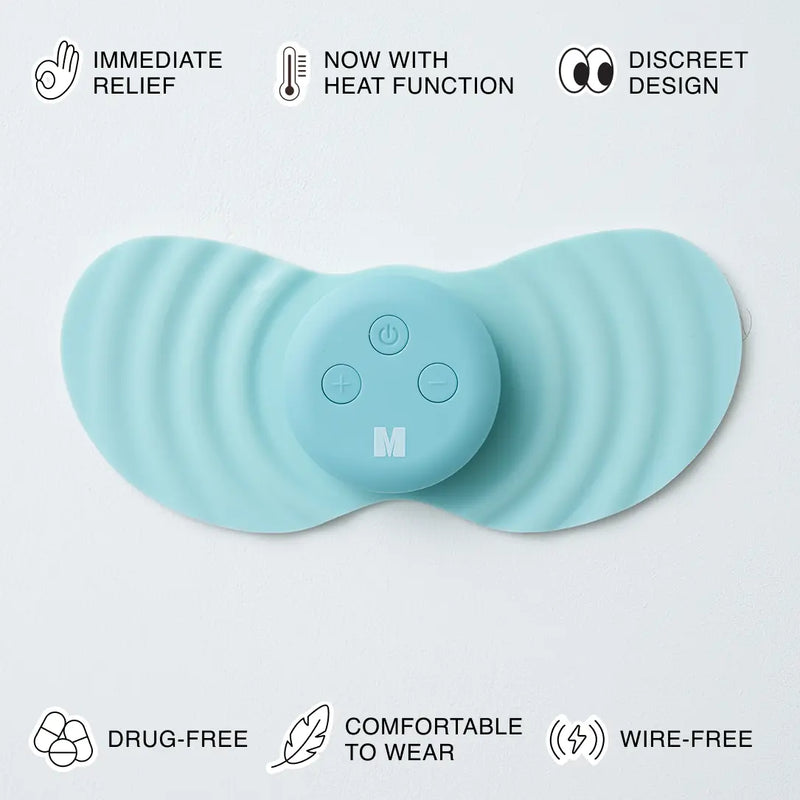
Myoovi Period Pain Relief Device 2.0
Wireless TENS + heat device designed to provide a more portable, period-focused alternative to a conventional wired TENS setup.
£79.99
- TENS + built-in heat
- Wireless wearable design
- 30 intensity levels
- 60-day trial
What Are You Actually Paying Extra For?
Myoovi 2.0 combines TENS, heat, a wireless wearable design and 30 intensity levels. Myoovi also lists USB-C charging, around 5–10 hours of battery life depending on intensity, a 60-day trial and a one-year warranty. [1]
The practical difference is convenience. If wires, carrying a controller or using a separate heat pack make a normal TENS machine awkward for work, travel or moving around, Myoovi removes some of that friction.
Community discussions reflect the same trade-off. Some users describe Myoovi’s main advantages as being thin, portable and discreet, while others question paying significantly more when the electrical-stimulation technology is still TENS. [4]
The premium therefore makes more sense as a usability upgrade than as proof of better pain relief.
Does Myoovi Relieve Pain Better Than a Regular TENS Machine?
A 2024 Cochrane review found that high- and low-frequency TENS may reduce primary dysmenorrhoea pain compared with placebo or no treatment, but the certainty of the evidence was low to very low. [2]
That evidence supports TENS as a category-level option. It does not show that Myoovi performs better than another commercial TENS machine.
The distinction is especially important for endometriosis. The Cochrane review concerned primary dysmenorrhoea, rather than endometriosis-related pain. Myoovi users discussing endometriosis report mixed experiences: some describe meaningful relief, while others report only partial benefit or question paying extra for a branded TENS device. [7]
If your buying decision depends mainly on stronger pain relief, the available evidence does not give Myoovi a clear clinical advantage. Its stronger argument is whether the design makes TENS easier to use in your routine.
Where Myoovi 2.0 Has a Practical Advantage

Wireless wear: Myoovi is designed without hanging leads, which becomes relevant if you want to use it under clothing, while working or while moving around. [1]
Built-in heat: Myoovi 2.0 combines electrical stimulation and heat in one device. If you normally use both TENS and a heat pad, that reduces the need for two separate products. [1]
Period-focused setup: its Butterfly Pad is designed around the lower-abdomen use case instead of using a general-purpose electrode layout. That makes setup simpler, but also creates dependence on Myoovi-specific pads. [3]
What Does Myoovi Cost After the Initial Purchase?
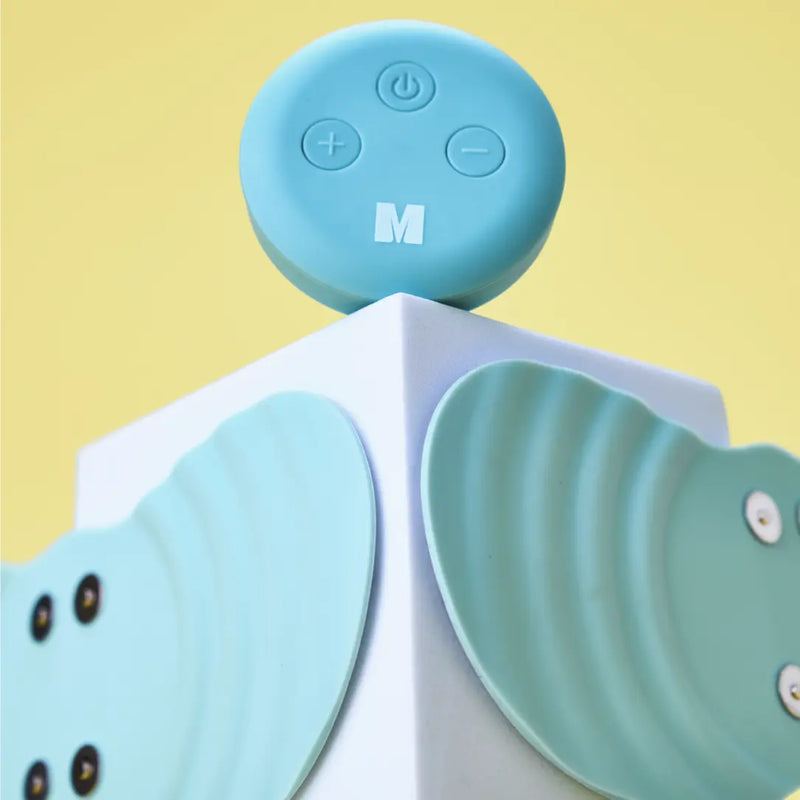
The £79.99 purchase price is not the full ownership cost. Myoovi 2.0 replacement Butterfly Pads are listed at £15 for a one-time pack of two or £13.50 on subscription. Myoovi says a pad can last up to 20 uses, while its FAQ gives a typical range of around 20–30 uses. [3]
The 2.0 pads are also not compatible with the original Myoovi because the connector and heating setup differ. [3]
This cost matters more for frequent users. Someone using Myoovi only on occasional difficult days may replace pads slowly. Someone expecting regular use should include pad lifespan, availability and refill costs in the buying decision.
For the detailed ownership-cost side of that decision, see our Myoovi replacement pads guide for lifespan, V1 vs V2 compatibility, refill pricing and estimated yearly cost.
When Does a Regular TENS Machine Make More Sense?
A conventional TENS machine becomes more attractive when cost and flexibility matter more than discreetness. Owner discussions comparing Myoovi with standard TENS devices include users who feel they can get the stimulation they need without paying for the wearable period-specific format. [8]
That does not mean every cheap TENS machine is equivalent. Electrode quality, controls, battery design and portability vary widely between models.
But if you already know conventional TENS works for you and you are comfortable with wires, Myoovi may be solving a convenience problem you do not actually have.
What Myoovi 2.0 Complaints Should You Know About?
Recent user feedback raises several Myoovi 2.0 usability concerns. Reddit and Trustpilot discussions mention beeping, timer limits, changing pulse patterns, reduced control over a preferred pulse pattern and a bulkier feel compared with V1. [5] [6]
These reports should not be treated as universal defects. Later comments in the same community discussion suggest some newer units may behave differently, so the more defensible conclusion is that 2.0 usability has been inconsistent across owner reports. [5]
If silent operation or keeping one preferred pulse pattern matters to you, this is worth checking against the current product specifications before ordering.
Who Should Choose Myoovi, and Who Should Save the Money?
Choose Myoovi 2.0 if:
- You want TENS you can wear while working, travelling or moving around.
- Built-in heat is genuinely useful to you.
- You value a compact wireless setup more than the lowest purchase price.
- You are comfortable buying Myoovi-specific replacement pads.
- The 60-day trial makes the higher upfront price easier to test. [1]
Choose a regular TENS machine if:
- Your main priority is electrical stimulation at a lower cost.
- You already know conventional TENS is sufficient for you.
- Wires or a separate controller do not bother you.
- You prefer broader electrode and device choices.
- You do not need built-in heat or a period-specific wearable format.
Final Verdict: Is Myoovi Worth Paying Extra For?
Myoovi’s premium is easier to justify for convenience than for superior pain relief. Its clearest differentiators are wireless wear, integrated heat, portability and a period-focused setup. The sources reviewed here do not show that it provides inherently stronger TENS relief than a conventional machine.
If those convenience features solve a genuine problem in how you expect to use TENS, Myoovi can make sense despite the higher upfront price and replacement-pad costs.
If they do not, a regular TENS machine may offer the more economical route without making you pay for features that do not materially improve your own use case.
Myoovi Period Pain Relief Device 2.0
Best suited to buyers who specifically value wireless wear, integrated heat and a compact period-focused TENS setup.
£79.99
FAQs
Is Myoovi just a TENS machine?
Myoovi 2.0 uses TENS as its electrical-stimulation technology, but adds a wireless period-focused format and built-in heat. [1]
Does Myoovi work better than normal TENS?
The sources reviewed here do not establish that. Cochrane found that TENS may reduce primary period pain, but the evidence was low to very low certainty and was not specific to Myoovi. [2]
Does Myoovi work for endometriosis pain?
Some users report meaningful relief while others report limited benefit. Those experiences are anecdotal, and the independent evidence cited here concerns primary dysmenorrhoea rather than endometriosis. [7] [2]
Sources & References
-
Myoovi — Period Pain Relief Device 2.0
Supports product price, TENS + heat, intensity levels, battery, 60-day trial and warranty.
Open source ↗ -
Cochrane — TENS for Primary Dysmenorrhoea
Independent evidence on TENS for period pain and evidence-certainty limitations.
Open source ↗ -
Myoovi — Replacement Butterfly Pads 2.0
Supports replacement-pad pricing, lifespan guidance and V1/V2 compatibility.
Open source ↗ -
Reddit — UK TENS Machine Recommendations
Anecdotal owner discussion covering convenience, price, placement and replacement-pad dependence.
Open source ↗ -
Reddit — New Myoovi 2.0
Anecdotal V1/V2 discussion covering beeps, timer and pulse-pattern behaviour.
Open source ↗ -
Trustpilot — Myoovi Reviews
Public customer reports covering pain relief, controls, usability and irritation. These reports do not establish a failure rate.
Open source ↗ -
Reddit — Myoovi for Endometriosis
Mixed anecdotal user experiences and value concerns.
Open source ↗ -
Reddit — TENS Devices Tried for Endometriosis Pain
Owner comparison discussing Myoovi V1, conventional TENS and portability trade-offs.
Open source ↗
 ✓