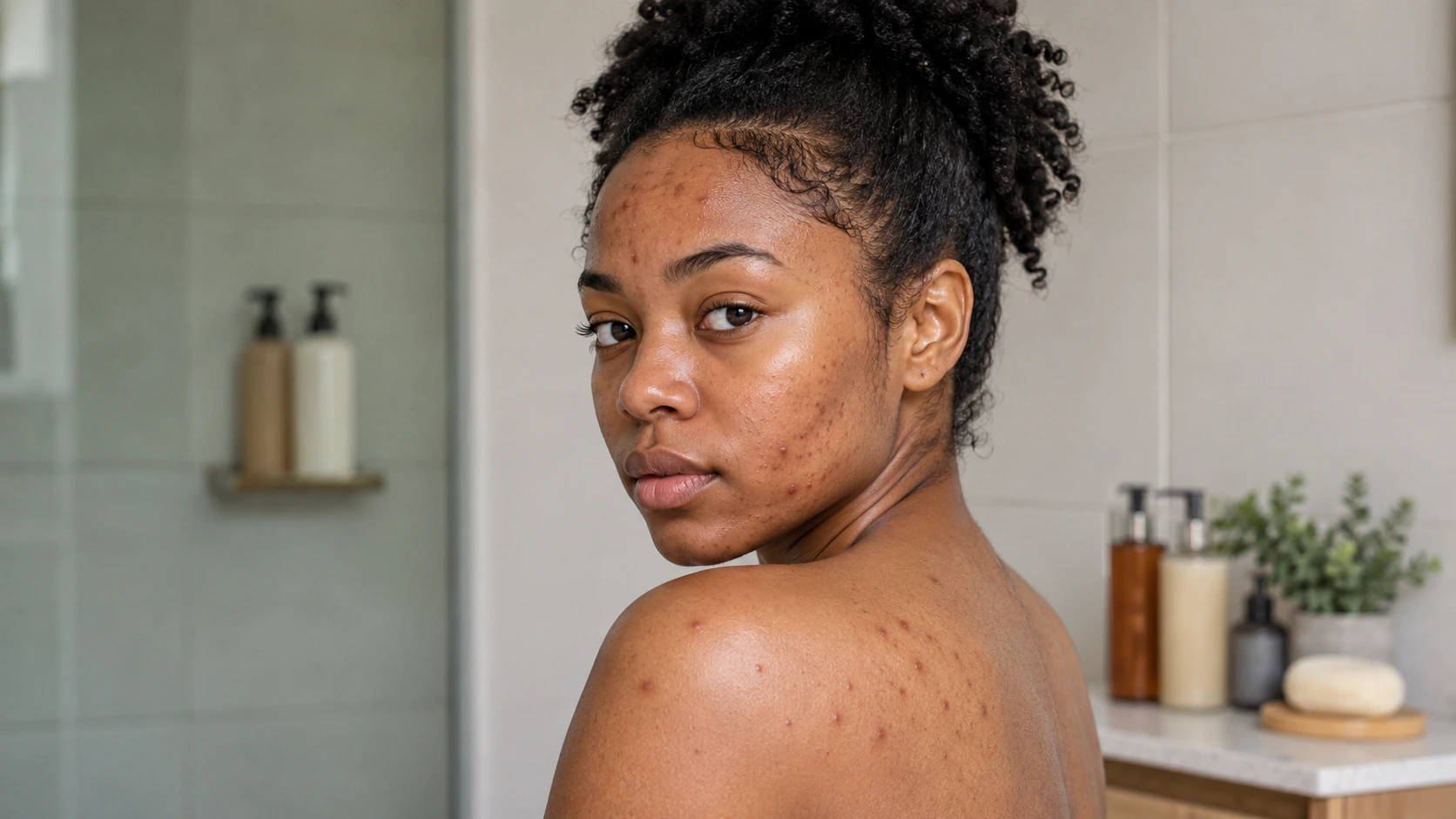
Yes. Hair-care products can contribute to acne in some people, especially when oils or product residue repeatedly contact the hairline, forehead, neck or other breakout-prone skin. The important question is not whether hair products can cause breakouts—it is whether your specific breakout pattern actually points to your shampoo, conditioner or styling routine.
This guide focuses on identifying that pattern, removing likely triggers and deciding what to do next. For product-label and shopping guidance, use our separate Non-Comedogenic Hair Care guide.
Hair products can cause breakouts—but location and timing matter
The American Academy of Dermatology says shampoos, conditioners and styling products can cause whiteheads and other acne around the hairline, upper forehead and back of the neck. Oily pomades and other residue-forming products are well-known examples.
A product-contact cause becomes more plausible when breakouts repeatedly appear where hair or hair products touch the skin, start after a new product or heavier routine, and improve after the suspected product is removed.
That pattern is still not proof. Acne can have multiple causes, and an itchy, burning or scaly reaction may point more toward irritation or contact dermatitis than acne.
Sources: American Academy of Dermatology; DermNet — Shampoo.
The four clues that make a hair-product trigger more likely
1. The breakouts follow contact zones
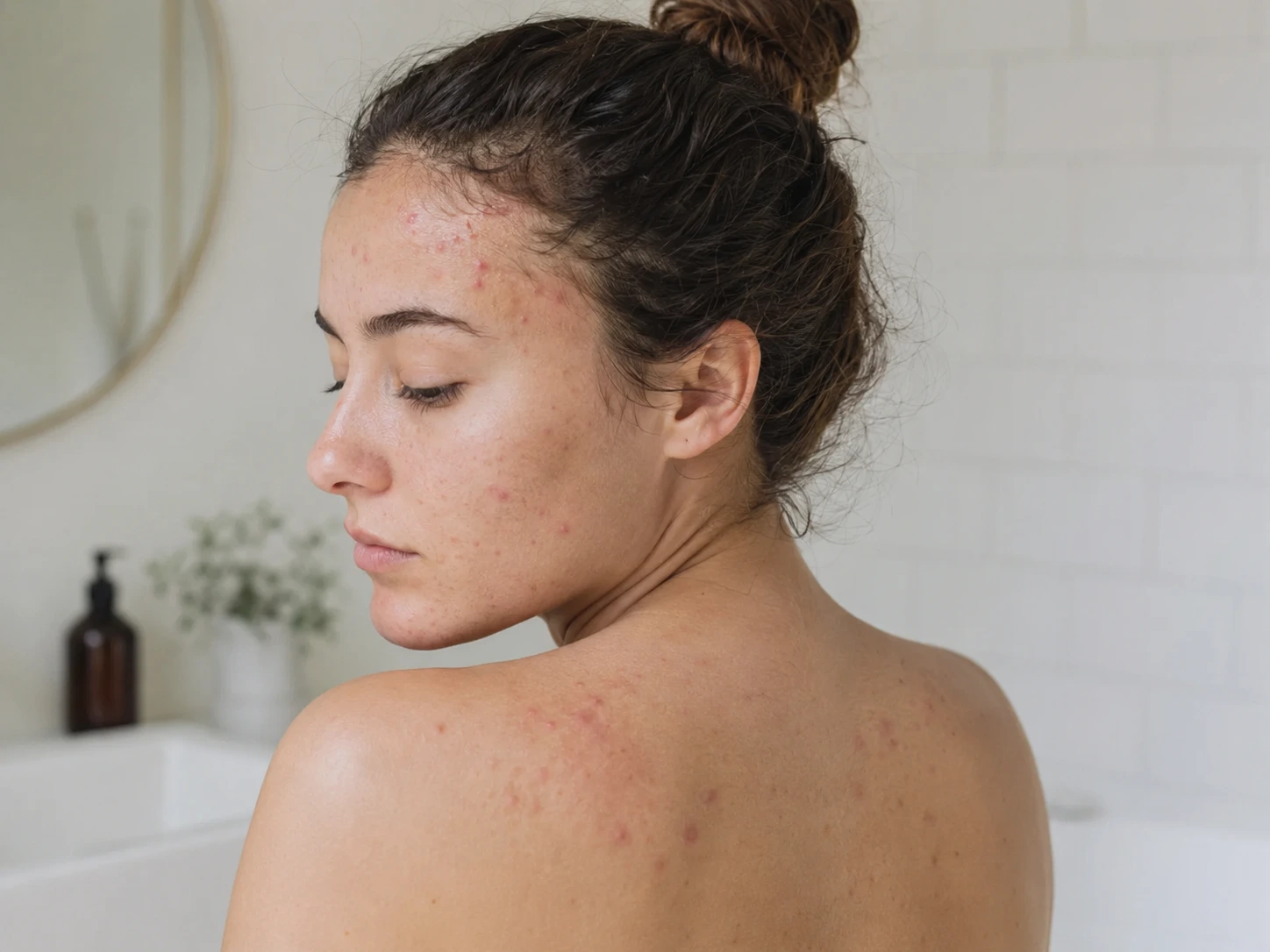
Think hairline, forehead, temples, back of the neck, shoulders or upper back—areas where styling products, conditioner runoff or product-coated hair commonly touch skin.
2. The timing matches a product change
A new conditioner, hair oil, pomade, leave-in, dry shampoo or styling cream can be a useful clue if the breakout pattern appears after the routine changes.
3. The product is oily, heavy or persistent
Oils, waxes, pomades and leave-in products stay on hair longer and have more opportunity to transfer onto skin, clothing or pillowcases.
4. The pattern improves when exposure stops
The strongest practical clue is improvement after removing the likely trigger and cleaning surfaces that hold residue. AAD notes that product-related acne can take roughly 4–6 weeks to clear.
Where hair-product breakouts usually show up
| Area | Common contact route | What to check |
|---|---|---|
| Hairline / temples | Pomades, edge control, gels, oils, bangs | Does the acne trace the exact edge of the hairline? |
| Upper forehead | Bangs, leave-ins, styling creams, spray | Do bumps sit under or beside product-coated hair? |
| Back of neck | Shampoo/conditioner residue, styling products, long hair | Does the area improve when hair is kept off the neck? |
| Shoulders / upper back | Conditioner, hair masks, oils rinsing down the body | Are breakouts worse after deep-conditioning or mask days? |
| Cheeks / jawline | Hair transfer, pillowcase residue | Does one side worsen where you sleep against product-coated hair? |
Which hair products are most worth investigating first?
Do not throw away your entire routine at once. Start with the products that have the most skin contact or leave the heaviest residue.
Pomades, waxes & edge control
High priority when bumps sit directly along the hairline or temples.
Conditioner & hair masks
High priority when breakouts cluster on the neck, shoulders or upper back after rinsing.
Hair oils & leave-ins
High priority when oily face-framing hair or pillowcase transfer matches the breakout area.
Dry shampoo
Worth checking when there is repeated buildup around the scalp and hairline.
Styling sprays & creams
Worth checking when mist or product regularly reaches the forehead, neck or shoulders.
Shampoo
Possible, but contact time is usually shorter than leave-in products. Residue or irritation can still matter.
Do not diagnose the problem from one ingredient name
There is no reliable universal list where one ingredient automatically means “this will cause acne.” The same formula can work for one person and create problems for another.
For diagnosis, the more useful variables are:
- how heavy or oily the full formula is;
- whether it is rinse-off or leave-in;
- how much you use;
- where the product touches your skin;
- how long residue stays on skin, hair, pillowcases or headwear;
- whether the breakout pattern changes when exposure stops.
If your next question is how to evaluate labels such as non-comedogenic, oil-free, fragrance-free or sensitive-skin friendly, that belongs in our dedicated Non-Comedogenic Hair Care buyer guide.
Shampoo vs conditioner: which is more likely to be the problem?
Shampoo
Shampoo can be relevant if residue remains around the hairline or neck, or if the formula irritates your skin. DermNet notes that shampoo residue can contribute to follicular occlusion along the hairline.
Conditioner
Conditioner is often a strong suspect because it is designed to coat and soften hair. If it runs over the face, neck, shoulders or back and is not washed off the skin afterward, exposure can be greater.
The best test is not “which category is worse?” It is “which product’s contact pattern matches where my breakouts occur?”
A cleaner 4–6 week way to test whether hair products are contributing
Identify the highest-contact suspect
Choose one product that most clearly matches the breakout area—such as pomade for hairline bumps or conditioner for upper-back breakouts.
Stop or replace one major variable
Do not replace shampoo, conditioner, leave-in and skincare all at once. You want enough consistency to know what changed.
Remove old residue
Wash pillowcases, hats, headbands and other surfaces that repeatedly contact product-coated hair. AAD specifically recommends cleaning items that may hold hair-product residue.
Change shower order
Shampoo and condition first. Rinse thoroughly. Then cleanse your face, neck, chest, shoulders and back so hair-product residue is not the last thing left on your skin.
Track location, not just “good skin / bad skin”
Once or twice a week, note whether the exact contact-zone bumps are fewer, flatter or less frequent. Photos taken in similar lighting can make the pattern easier to compare.
Give the pattern enough time
AAD says acne related to hair-care products may take about 4–6 weeks to clear after the trigger is removed. Do not interpret two good days—or two bad days—as proof.
When it may not be acne
Hair products can also trigger irritation or allergic contact dermatitis. DermNet notes that a rinse-off pattern around the hairline or behind the ears can suggest contact dermatitis from shampoo or other hair-care products.
Acne is more likely to look like clogged pores, whiteheads or acne bumps. A reaction that is especially itchy, burning, red, swollen, scaly or rash-like deserves a different level of caution.
If a suspected cosmetic product causes a concerning reaction, stop using it and seek appropriate medical advice. If acne does not improve after removing the suspected trigger, AAD recommends considering dermatologist help because another cause may be involved.
What should you switch to if a hair product seems to be contributing?
This article’s job is diagnosis, not to declare one universal “acne-safe” shampoo. Once the contact pattern looks convincing, move to product selection.
Start with our Non-Comedogenic Hair Care guide to understand the labels and trade-offs that matter when replacing a product.
For a real-world brand example, our updated SEEN Haircare Review evaluates a premium hair-care line explicitly positioned around acne-prone and sensitive skin. If you are choosing between two fragrance-conscious options, see SEEN vs Vanicream Shampoo.
Those pages answer a different question from this one: not “is my hair routine part of the problem?”, but “what should I buy instead?”
Common mistakes when testing a suspected hair-product trigger
Changing five products at once
You may improve, but you will not know which change mattered.
Ignoring pillowcases and hats
Old residue can keep re-contacting the same areas even after you stop using the original product.
Assuming “natural” means low-risk
Natural origin does not tell you whether a full formula will suit your skin.
Judging after one wash
Product-related acne does not disappear instantly once exposure stops.
Focusing only on shampoo
Leave-ins, pomades, oils and conditioner may have much longer skin contact.
Treating every bump as acne
Itchy or rash-like reactions can require a different explanation and different care.
FAQ
Can shampoo cause acne?
Yes, it can contribute in some people, particularly when oily or residue-forming product reaches acne-prone skin. Shampoo is only one possible source; conditioner and styling products may have more persistent contact.
Can conditioner cause back acne?
It can contribute if conditioner repeatedly runs over the shoulders or back and residue remains on the skin. Washing the body after rinsing conditioner is a reasonable way to reduce that contact.
Why do I get acne only around my hairline?
A hairline-only pattern makes hair products, oily pomades, edge-control products, styling gels, hats and product residue worth investigating. It does not prove one specific product is responsible.
How long does hair-product acne take to clear?
AAD says acne linked to hair-care products can take about 4–6 weeks to clear after the acne-causing product stops contacting the skin.
Should I buy a non-comedogenic shampoo?
It can be a useful next step if the contact pattern points toward hair products, but “non-comedogenic” is not a guarantee for every person. See our Non-Comedogenic Hair Care guide for the buying decision.
When should I see a dermatologist?
If the condition is painful, severe, scarring, unusually itchy/rash-like, or does not improve after removing the suspected product trigger, professional evaluation can help distinguish acne from other causes.
Sources
- American Academy of Dermatology — Are your hair care products causing breakouts?
- American Academy of Dermatology — Skin-care habits that can worsen acne
- DermNet — Shampoo
HealthAffPro uses these sources to explain general patterns. They do not establish that a specific reader’s breakout is caused by a specific product.
 ✓