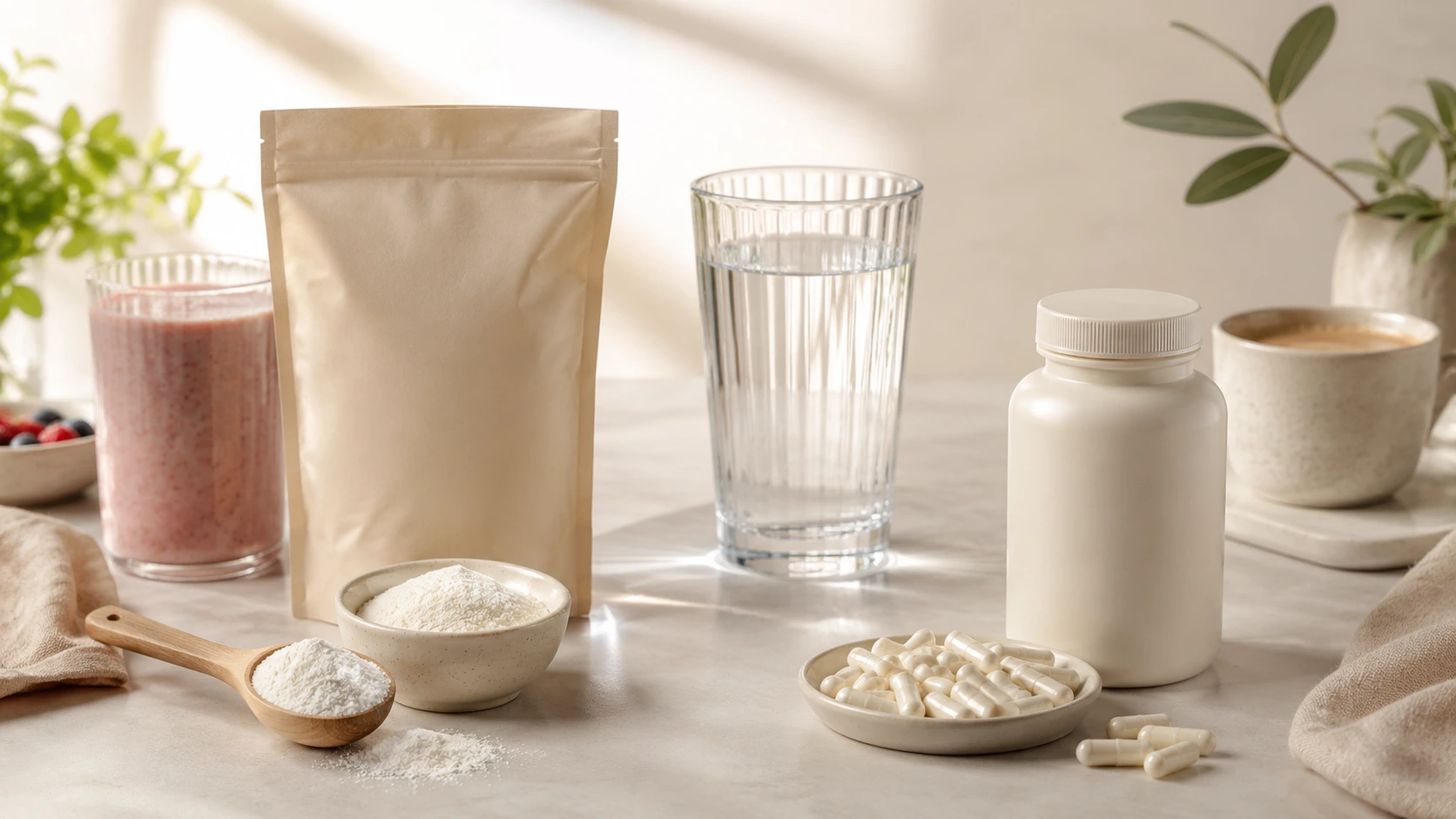
Collagen powder vs capsules is one of the most common questions people ask before starting a collagen supplement routine. Both options can support daily wellness, but they are not equally convenient, flexible, or practical for every lifestyle.
Collagen powder usually gives a larger serving size and works well in coffee, smoothies, yogurt, oatmeal, or water. Collagen capsules are easier to travel with, simpler to swallow, and better for people who do not want to mix a drink. The better choice depends on your goal: skin elasticity, hair and nails, joint health, convenience, dosage, taste, budget, and consistency.
Last Updated: May 12, 2026
Quick answer: Collagen powder is usually better if you want a higher collagen serving, flexible mixing options, and better cost per serving. Collagen capsules are better if you want convenience, travel-friendly use, no taste, and a simple daily routine. Both can be effective if they contain quality collagen peptides and you take them consistently.
TL;DR
- Collagen powder usually provides a larger collagen serving than capsules.
- Collagen capsules are easier for travel and better for people who dislike mixing powders.
- Both powder and capsules can use collagen peptides or hydrolyzed collagen.
- Powder may be better for skin, hair, nails, and joints if you need a meaningful daily dose.
- Capsules may be easier to use consistently, but you may need several pills per serving.
- The best collagen supplement is the one that matches your goal, dosage needs, budget, and routine.
Table of Contents
- Collagen powder vs capsules: core answer
- What is collagen powder?
- What are collagen capsules?
- Absorption and bioavailability
- Dosage comparison
- Which is better for skin?
- Which is better for hair and nails?
- Which is better for joints?
- Daily wellness routine
- Comparison table
- Buyer decision guide
- Common mistakes
- Expert insight
- Trusted sources
- FAQs
- Conclusion
Collagen Powder vs Capsules: What Is the Real Difference?
The main difference between collagen powder and collagen capsules is the format. Collagen powder is loose collagen protein that you mix into drinks or foods. Collagen capsules are collagen powder or peptides packed into pill form.
Both can contain collagen peptides, hydrolyzed collagen powder, marine collagen, bovine collagen, or multi-collagen blends. The body does not care whether collagen came from a scoop or a capsule once it reaches digestion. What matters more is the collagen type, serving size, consistency, product quality, and whether the format fits your lifestyle.
For many people, collagen powder is easier to dose meaningfully because one scoop may provide several grams of collagen. Capsules are convenient, but each capsule has limited space, so a full serving may require multiple pills.
Example
If one scoop of collagen protein powder provides 10 grams of collagen, a capsule product may require many capsules to reach the same amount. That does not mean capsules are useless, but it does mean dosage comparison matters.
Real-world use
If you already make coffee, smoothies, oatmeal, or yogurt every morning, collagen powder may blend naturally into your routine. If you travel often or hate mixing drinks, collagen capsules may be easier to maintain.
What Is Collagen Powder?
Collagen powder is a powdered collagen supplement usually made from hydrolyzed collagen or collagen peptides. “Hydrolyzed” means the collagen has been broken down into smaller peptide chains, which makes it easier to mix into liquids and easier for the body to digest.
Collagen powder may come from bovine, marine, chicken, or multi-collagen sources. Bovine collagen powder usually provides type 1 and type 3 collagen. Marine collagen powder is often rich in type 1 collagen. Chicken collagen is commonly associated with type 2 collagen, which is more joint-focused.
Collagen powder benefits often include flexibility, higher serving size, better cost per gram, and easy mixing into a daily wellness routine. The downside is that some powders have taste, texture, clumping, or preparation issues.
Higher Serving Size
Powder usually makes it easier to take several grams of collagen in one serving.
Flexible Use
You can mix collagen powder into coffee, smoothies, oatmeal, yogurt, shakes, or water.
Better Cost Per Serving
Powder often gives more collagen per purchase compared with small capsule servings.
Taste & Texture
Some powders can taste noticeable or clump if mixed poorly.
Example
A person who drinks coffee every morning may add unflavored hydrolyzed collagen powder to the cup. This turns an existing habit into a simple collagen routine without adding another step.
Real-world use
Collagen powder works well for people focused on skin elasticity, hair and nails, joint health, and daily wellness because it is easier to take a practical serving size consistently.
What Are Collagen Capsules?
Collagen capsules are collagen supplements in pill form. They may be labeled as collagen capsules, collagen tablets, collagen pills, collagen peptides capsules, or hydrolyzed collagen capsules. They are designed for convenience and simple daily use.
The biggest benefit of collagen capsules is ease. You do not need to mix anything, taste anything, or prepare a drink. This makes capsules useful for travel, work bags, gym bags, and people who already take other daily supplements.
The main limitation is serving size. Capsules can only hold a small amount of collagen. If you want several grams per day, you may need to take multiple capsules. This can make capsules less convenient than they first appear.

Example
A busy professional may keep collagen capsules in a work bag and take them with lunch. This is easier than carrying a powder tub or mixing collagen in public.
Real-world use
Collagen capsules are best for people who want a no-mess supplement routine, dislike flavored powders, travel frequently, or prefer swallowing pills over mixing drinks.
Collagen Absorption and Bioavailability: Does Powder Absorb Better Than Capsules?
Collagen powder vs capsules absorption is often misunderstood. In most cases, the format itself is not the most important factor. The more important question is whether the product contains hydrolyzed collagen or collagen peptides.
Hydrolyzed collagen and collagen peptides are broken down into smaller chains of amino acids. These peptides are digested and absorbed, then the body uses those building blocks where needed. The body does not send collagen directly to your skin, hair, nails, or joints just because you consumed it.
If both a powder and a capsule contain the same quality collagen peptides at the same dose, their absorption potential may be similar. The practical difference is that powder often makes it easier to reach a meaningful dose.
Example
A 10-gram serving of collagen peptides powder and a 10-gram equivalent serving of collagen peptides capsules may be similar in collagen content. But reaching 10 grams with capsules may require many pills, depending on the product.
Real-world use
Do not choose collagen based only on the word “bioavailability.” Check the form, dose, source, third-party testing, and whether you can take the product consistently.
Collagen Powder Dosage vs Collagen Capsules Dosage
Collagen powder dosage is usually easier to control because you can use a scoop and adjust the amount. Many collagen powders provide around 5 to 20 grams per serving, depending on the product.
Collagen capsules dosage varies widely. Some capsule products provide a much smaller amount per serving, while others require several capsules. This is why you should always read the Supplement Facts panel instead of assuming capsules provide the same amount as powder.
There is no single perfect collagen dose for everyone. The right amount depends on your goal, body size, diet, product type, and health status. Many skin-focused studies use collagen peptide doses in gram amounts, so dosage matters when comparing powder and capsules.
Dosage Reality Check
- Check grams of collagen per serving, not just capsule count.
- Compare cost per gram, not only bottle price.
- Look for collagen peptides or hydrolyzed collagen.
- Use the product consistently for several weeks before judging results.
- Ask a healthcare professional if you are pregnant, breastfeeding, managing kidney disease, or taking medication.
Example
A powder may list 10 grams of collagen per scoop. A capsule product may list 2 grams per serving of four capsules. In that case, the powder provides five times more collagen per serving.
Real-world use
If you want collagen for skin, hair, nails, and joints, compare the actual collagen amount per day before choosing powder or capsules.
Collagen Powder or Capsules for Skin Elasticity?
Collagen for skin elasticity is one of the most popular reasons people buy collagen supplements. The goal is usually better skin hydration, firmness, elasticity, and support for visible signs of aging such as fine lines and wrinkles.
For skin goals, collagen powder may be more practical because it often delivers a larger serving of collagen peptides. However, collagen capsules for skin can still be useful if the dose is meaningful and the product is taken consistently.
Skin results depend on more than collagen. Sunscreen, vitamin C, protein intake, hydration, sleep, skincare, and avoiding smoking are all important. Collagen can support the routine, but it cannot cancel out poor skin habits.

Example
A woman over 30 may choose collagen powder for skin because she wants a daily 10-gram serving in coffee. Another person may choose capsules because they do not like mixing drinks. Both can work if the dose and quality are appropriate.
Real-world use
For collagen for skin elasticity, choose a format you can use daily and pair it with sunscreen, enough protein, vitamin C-rich foods, and a consistent skincare routine.
Collagen Powder or Capsules for Hair and Nails?
Collagen for hair and nails is mostly about amino acid support. Hair and nails are made mainly from keratin, but keratin production depends on adequate protein and amino acids. Collagen peptides can contribute amino acids such as glycine and proline.
Collagen powder for hair and nails may be more effective from a practical standpoint if it provides a larger serving. Collagen capsules for hair and nails may be easier to remember if you already take daily pills.
Hair thinning and brittle nails can also be caused by iron deficiency, thyroid issues, stress, postpartum changes, crash dieting, low protein intake, or harsh styling practices. Collagen is not a complete solution for every hair or nail concern.
Example
A person with brittle nails may take collagen capsules daily because they are easy to keep beside a toothbrush. Another person may use collagen powder in breakfast yogurt because it fits their protein-focused morning routine.
Real-world use
For hair strength and nail strength, use collagen as one part of a broader plan: protein-rich meals, gentle hair care, enough calories, mineral support, hydration, and medical evaluation for unexplained hair loss.
Collagen Powder or Capsules for Joint Health?
Collagen for joint health is usually connected with cartilage support, connective tissue, and mobility. Type 2 collagen is especially relevant for cartilage, while hydrolyzed collagen peptides are commonly used in joint-support routines.
Collagen powder for joints may be useful if you want a larger serving and plan to use it after workouts or with breakfast. Collagen capsules for joints may be useful if you want a simple pill routine, but you must check whether the dose is strong enough.
Joint health depends on many factors: strength training, mobility work, healthy weight, footwear, recovery, inflammation, injury history, and medical conditions. Collagen may support joint comfort for some people, but persistent pain should not be ignored.
Example
A gym user may drink collagen powder after training to support a recovery routine. An older adult may prefer capsules because they are easier to take with other supplements.
Real-world use
For collagen for joint health, choose a supplement format that you can take consistently and combine it with safe movement, strength training, warmups, recovery, and professional advice for ongoing pain.
Which Collagen Form Is Easier for Daily Wellness?
The best collagen supplement for daily wellness is not always the strongest product on paper. It is the product you can use consistently without stress. A high-dose powder that sits unused in your cabinet is less helpful than a moderate capsule routine you actually follow.
Collagen powder works well for people who enjoy drinks, smoothies, coffee, oatmeal, or protein-style routines. It also works well for people who want flexibility and better cost per serving.
Collagen capsules work well for people who want a travel-friendly supplement, hate taste and texture issues, dislike preparation, or already have a pill organizer.
Powder is easier if you:
- Drink coffee, smoothies, or shakes daily.
- Want a higher collagen serving.
- Care about cost per gram.
- Prefer flexible dosage.
- Do not mind mixing a drink.
Capsules are easier if you:
- Travel often.
- Dislike powder texture or flavor.
- Want no prep and no mess.
- Already take daily supplements.
- Prefer a pill-based routine.
Example
A busy parent may prefer capsules because they can take them quickly. A fitness-focused person may prefer collagen protein powder because it can be added to a post-workout shake.
Real-world use
Match the supplement to your real life, not your ideal routine. Consistency is usually more important than choosing the trendiest collagen format.
Comparison Table: Collagen Powder vs Capsules
This table gives a clear side-by-side comparison of collagen powder vs collagen capsules for daily wellness, skin, hair, nails, joints, dosage, and convenience.
| Feature | Collagen Powder | Collagen Capsules |
|---|---|---|
| Best for | Higher serving size, flexible use, smoothies, coffee, daily drinks | Convenience, travel, pill routines, no taste |
| Typical serving size | Often several grams per scoop | Often lower per capsule; may require multiple pills |
| Convenience | Requires mixing | Very convenient and portable |
| Taste | May be unflavored, flavored, or slightly noticeable | No taste if swallowed quickly |
| Texture | May clump or change drink texture | No texture issue |
| Dosage control | Easy to adjust scoop amount | Less flexible unless taking more capsules |
| Cost per gram | Often better value | Often more expensive per gram |
| Best for beginners | Good if you already drink coffee or smoothies | Good if you want a simple no-prep routine |
| Skin, hair, nails | Practical because higher servings are easier | Useful if dose is adequate and consistent |
| Joint support | Good for higher-dose routines | Good for convenience, but check serving size |
Buyer Decision Guide: How to Choose Collagen Powder or Capsules
Choosing between collagen powder and capsules should be based on your goal, not just product popularity. A good collagen supplement should fit your body, budget, and daily habits.
Choose Collagen Powder If:
- You want a higher collagen serving per day.
- You want better value per gram.
- You like adding supplements to coffee, smoothies, oatmeal, yogurt, or shakes.
- You want flexibility with dosage.
- You are focused on skin elasticity, joint health, or full daily wellness support.
Choose Collagen Capsules If:
- You want the easiest no-mix option.
- You travel often or need something portable.
- You dislike the taste or texture of collagen powder.
- You already use a supplement organizer.
- You are comfortable taking multiple capsules if needed.
What to look for before buying
- Look for collagen peptides or hydrolyzed collagen.
- Check the collagen source: marine, bovine, chicken, or multi-collagen.
- Check collagen type: type 1, type 2, or type 3.
- Compare grams of collagen per serving.
- Check added sugar, fillers, sweeteners, allergens, and flavoring.
- Look for third-party testing when possible.
- Avoid products that promise instant anti-aging, guaranteed hair growth, or medical cures.
Example
If your goal is skin and hair support, a type 1 and type 3 collagen peptide powder may make sense. If your goal is cartilage and joints, look for a product that clearly explains its joint-support collagen type and serving size.
Real-world use
Before buying, write down your main goal: skin, hair, nails, joints, convenience, or cost. Then choose the format that best supports that goal for at least 8 to 12 weeks.
Common Mistakes People Make When Choosing Collagen
Collagen supplements are easy to buy but easy to misunderstand. Avoid these common mistakes when comparing collagen powder vs capsules.
Mistake 1: Comparing bottle price instead of cost per gram
A capsule bottle may look cheaper, but it may provide much less collagen overall. Always compare grams of collagen per serving and cost per gram.
Mistake 2: Assuming capsules are always easier
Capsules are convenient, but if one serving requires several pills, they may become less convenient than one scoop of powder.
Mistake 3: Ignoring the collagen source
Marine collagen, bovine collagen, chicken collagen, and multi-collagen blends may offer different collagen types. Choose based on your goal.
Mistake 4: Expecting collagen to work overnight
Skin, hair, nails, and joints need time. Many people assess collagen after consistent use for several weeks, not a few days.
Mistake 5: Replacing good nutrition with collagen
Collagen is not a complete nutrition plan. You still need protein, vitamin C, minerals, healthy fats, sleep, hydration, and movement.
Expert Insight: Powder vs Capsules Is Really a Consistency Decision
The smartest way to compare collagen powder vs capsules is to separate science from lifestyle. If the collagen type, quality, and dose are the same, the body is mainly receiving amino acids and peptides. The format matters most because it affects serving size and consistency.
For people who want a stronger daily serving and better value, collagen powder usually wins. For people who want convenience, no taste, and travel-friendly use, collagen capsules may be the better fit.
The best collagen supplement is not always the one with the prettiest label. It is the one that provides a clear serving size, quality collagen peptides, transparent sourcing, and a routine you can realistically follow.
Example
A person who hates powder texture will not stay consistent with powder, even if it offers better value. A person who hates swallowing pills will not stay consistent with capsules. The best format is the one you will actually use.
Real-world use
Try one format for 8 to 12 weeks before switching. Track skin hydration, nail strength, hair feel, joint comfort, digestion, cost, and ease of use.
Trusted Sources and What the Research Says
Research on collagen supplements is growing, especially around skin hydration, elasticity, aging-related skin changes, and joint comfort. However, collagen benefits can vary depending on dosage, product type, study quality, age, diet, lifestyle, and consistency.
Helpful External Sources
For related wellness guides, visit the Health & Wellness category, explore the Vitamins and Supplements section, or return to the HealthAffPro homepage.
FAQs About Collagen Powder vs Capsules
Is collagen powder better than capsules?
Collagen powder is often better if you want a higher serving size, better cost per gram, and flexible mixing options. Capsules are better if you want convenience, portability, and no taste.
Are collagen capsules effective?
Collagen capsules can be effective if they contain quality collagen peptides and provide a meaningful dose. The main issue is that capsules often provide less collagen per serving than powder.
What is the best way to take collagen?
The best way to take collagen is the method you can use consistently. Powder works well in coffee, smoothies, yogurt, oatmeal, or water. Capsules work well for a simple no-mix routine.
Which collagen form absorbs better?
Absorption depends more on whether the product uses hydrolyzed collagen or collagen peptides than whether it is powder or capsule. If the dose and quality are equal, both formats can be useful.
Can collagen powder be mixed with coffee?
Yes, many unflavored collagen powders can be mixed into coffee. Add the powder gradually and stir well to reduce clumping. Always follow the product directions.
Is collagen powder or capsules better for hair and nails?
Powder may be more practical for hair and nails because it often provides a larger serving. Capsules can still work if the serving size is adequate and you take them consistently.
Which collagen is best for skin elasticity?
Type 1 collagen is commonly associated with skin elasticity, firmness, and beauty wellness. Many skin-focused supplements use marine collagen or bovine collagen peptides.
Which collagen is best for joint health?
Type 2 collagen is closely linked with cartilage and joint support. Hydrolyzed collagen peptides are also commonly used in joint wellness routines.
Conclusion: Collagen Powder vs Capsules — Which Should You Choose?
Collagen powder vs capsules comes down to dosage, convenience, consistency, and your personal wellness goal. Powder usually wins for higher serving size, flexible use, and better cost per gram. Capsules win for travel, no taste, no mixing, and simple daily use.
If your main goal is skin elasticity, hair and nails, or joint health, collagen powder may be the more practical option because it is easier to get a meaningful collagen serving. If your biggest challenge is consistency, collagen capsules may be better because they are simple and portable.
The right answer is not the same for everyone. Choose the format that fits your lifestyle, check the dose carefully, use it consistently, and support collagen with protein, vitamin C, sleep, hydration, exercise, and sun protection.
Actionable Advice
If you want the strongest daily serving and best value, start with collagen powder. If you want the easiest routine and hate mixing drinks, start with collagen capsules. Before buying, read the Supplement Facts panel and compare grams of collagen per serving.
Need the basics first? Read this guide on what collagen is and why it matters for skin, hair, nails, and joints.
 ✓
✓